See Productivity in Real Time.
Monitor employee activity, track work hours, and improve team efficiency with powerful insights.
Smart performance goals for employees are those goals which are clear, measurable, achievable, relevant and time bound. These goals help in improving employee’s performance so that managers can easily track work progress.
These are some quick examples
- Increase sales call by 15% before end of Q2
- Reduce average number customer wait times under 3 minutes by August
- Complete advance software training certification by Dec 31
- Publish 4 high quality blog post every month
- When using smart goals employees can focus 100% on their targets and make performance easier.
Rather than speaking something like – “I wish to improve my work,” a SMART goal would sound something like, “I will try to complete 3 professional training courses in the next 6 six months for improving my job skills.”
Such methodology helps workers to stay focused as well as track their daily progress much more easily.
Do SMART Goals Matter So Much at Workplaces?
Yes! Most workers, who work hard, don’t really know if they are moving in the right direction! Building SMART goals is something that gives them a clearer path. Advantages of smart goal setting include the following:
- More productivity
- Greater focus
- Better accountability
- More solid teamwork
- Quicker skill development
Firms that encourage such goal setting usually see better worker engagement as well as enhanced business performance.
Some Smart Goals for Employees Which Deliver Great Outcomes
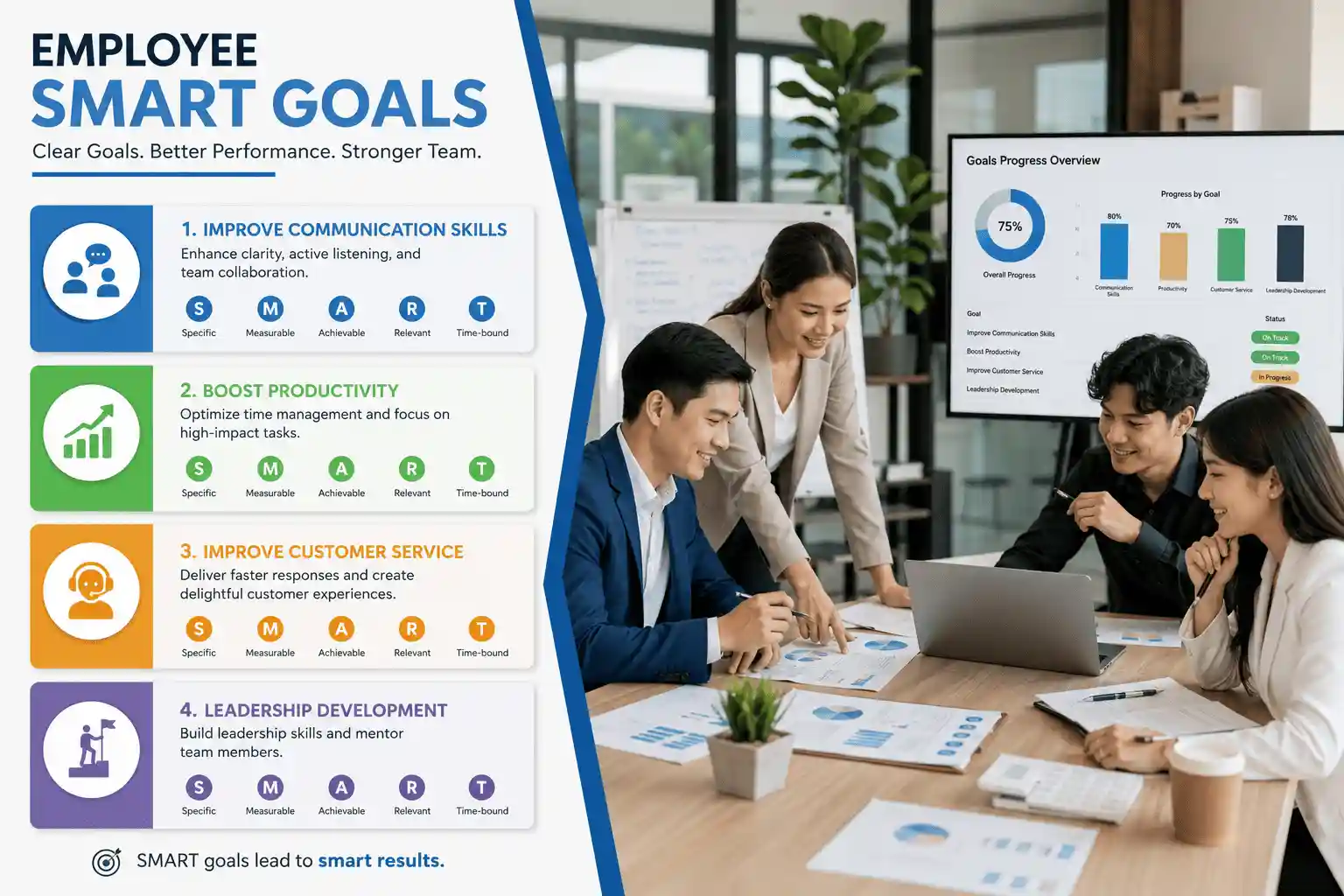
Here are some practical & smart goals from employees examples:
For Enhancing Communication Skills
Smart Goal: Attend 1 communication workshop as well as apply at least 3 new communication techniques within the next ninety days.
Boost Work Productivity
Smart Goal: Try to finish assigned tasks 15% faster over the next 3 months without lowering the quality.
Make Client Service Better
Smart Goal: Improve client satisfaction scores from 85 percent to 92 percent within the next 6 months.
Cultivate Leadership Skills
Smart Goal: Lead 1 team project successfully within the next 4 months.
Such examples are highly clear, truly measurable, & quite simple to track.
Some Real Employee Smart Goals Examples for Various Roles
Different jobs need different goals. Here are some employee smart goals examples:
- HR Team: Lower employee onboarding time from 14 days to 10 days within the next 4 months.
- Sales Team: Amplify monthly sales by at least ten percent within the next quarter.
- Marketing Team: Rise website traffic by twenty percent via content marketing within the next 6 months.
- Client Support Team: Lower average customer client time by 25 percent within the next 3 months.
Such smart goals tend to help workers comprehend what success truly looks like.
Forming Efficient Performance Goals for Employees
Here we will talk of the performance goals for employees. Forming such SMART goals is easy if you follow the following steps:
- Start by identifying an area for improvement.
- Then, try setting a specific, achievable result.
- After that, define measurable outcomes.
- Next, try ensuring the goal is realistic.
- Finally, set the deadline and start working towards it.
For example:
A Bad Goal: Enhance teamwork.
SMARTER Goal: Participate in 2 cross-department team projects within the next 6 months for improving collaboration skills.
Some Smart Work Goals Examples Which Boost Performance
To give you an understanding about smart work goals examples, employees can focus on daily work improvements, by using the below tips:
- Finishing reports before deadlines.
- Lessening mistakes by some specific percentage.
- Enhancing project completion rates.
- Studying about some new software tools.
Small improvements usually result in considerable long-term success.
Some Useful Employee Performance Goals Examples for Career Development
Career development goals tend to help workers move forward professionally. Some good employee performance goals examples include the following:
- Earn a professional certificate within 1 year.
- Train or mentor a junior employee for 6 months.
- Enhance your presentation skills via monthly practice sessions.
- Complete your leadership training by this year-end.
Such smart goals tend to contribute to long-term career growth substantially.
Importance of Measurable Goals for Employees
Without measuring, workers can’t really determine if they are making progress in the right direction. Some measurable goals for employees include the following:
- Augment client retention by ten percent
- Lower project delays by 15 percent
- Complete 5 training modules within 3 months.
Measurable goals tend to make success simpler to track as well as to celebrate.
Good Professional Development Goals Examples for Modern-Day Workers
Professional development tends to help workers stay competitive. Some professional development goals examples include the following:
- Learning some new technical skill(s).
- Finishing an industry certification.
- Attending professional conferences.
- Reading 1 industry-related book each month.
Continual learning tends to help workers stay valuable in changing workplaces.
Comprehending Smart Objectives for Employees
Smart objectives for employees tend to help workers connect daily tasks with bigger company goals. For instance: “Amplify client follow-up calls by 20 percent within the next 2 months to enhance client retention.” Such an objective is going to benefit both the worker as well as the company.
Easy Employee Goal Setting Examples That Any Worker Can Easily Follow
If you are very new to such goal setting, then you can start with easy ones. Here are some very simple-to-follow employees goal setting examples:
- Arrive on time each day for 3 months.
- Finish all assigned tasks before deadlines for the next 2 months.
- Attend 1 professional training session each quarter.
- Enhance email response times by 15 percent
Such easy goals usually form strong habits, which further result in larger achievements.
Common Mistakes Managers Make While Setting Employee Goals
Managers make some mistakes while setting employee goals and this leads to confusion and affects performance. Here are some common mistakes
- Setting too many goals
Too many goals create confusion. When employees have 10 different goals, it is hard for them to understand which goal is important.
- Making goal unrealistic
Set goals that are challenging but achievable. If an employee sells a few products every month and you set a target of 50 sales per month, it may not be realistic. Such goals are too difficult and employees get demotivated.
- Not tracking progress
Setting goals is not enough. You should also track employee progress. Many managers wait until the end of the month or year to review performance. By that time, it is difficult to make improvements and fix problems.
How to Track Employee Goals
- Schedule short meeting after 2 weeks on basis of goals
- Discuss upcoming challenges earlier
- Adjust goals if business priorities change
- Celebrate achievement when goals are achieved
Are You Ready to Enhance Employee Performance?
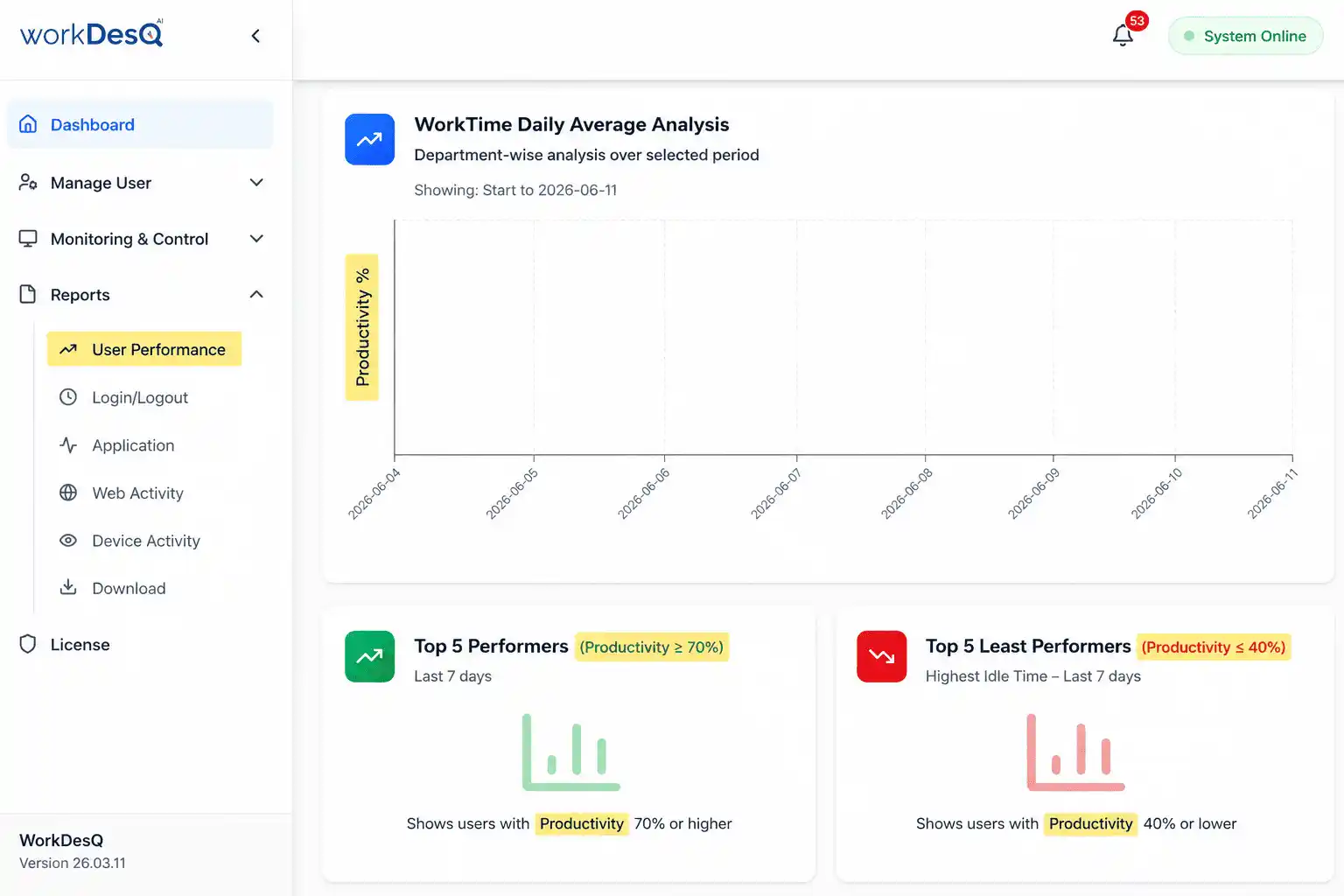
You can discover how workforce management & worker productivity solutions from WorkDesQ can help your company set, monitor, & achieve worker goals much more efficiently.
Ready to Track Employee Work More Efficiently?
Monitor productivity, track work hours, and manage your team with ease using WorkDesQ Employee Work Tracking Software.
Conclusion
By making use of some smart performance goals for employees’ examples, you can enhance your performance at work. Such goals give direction, better accountability, and even help workers achieve measurable success.