Micromanaging examples happen when a manager tries to control employees’ work on small matters and instead of trusting them, they begin to doubt their performance. Many employees experience micromanagement but they do not speak up and are not aware of it at first. Micromanaging starts with small things. Some common examples include
- Demanding updates from employees every hour
- Rewriting employees’ work instead of providing feedback
- Approving every small decision
- Monitoring work activity every minute
- Repeatedly interrupting employees during work
Here managers destroy employees productivity and creativity then wonder why work is not getting done and the real reason is micromanagement.
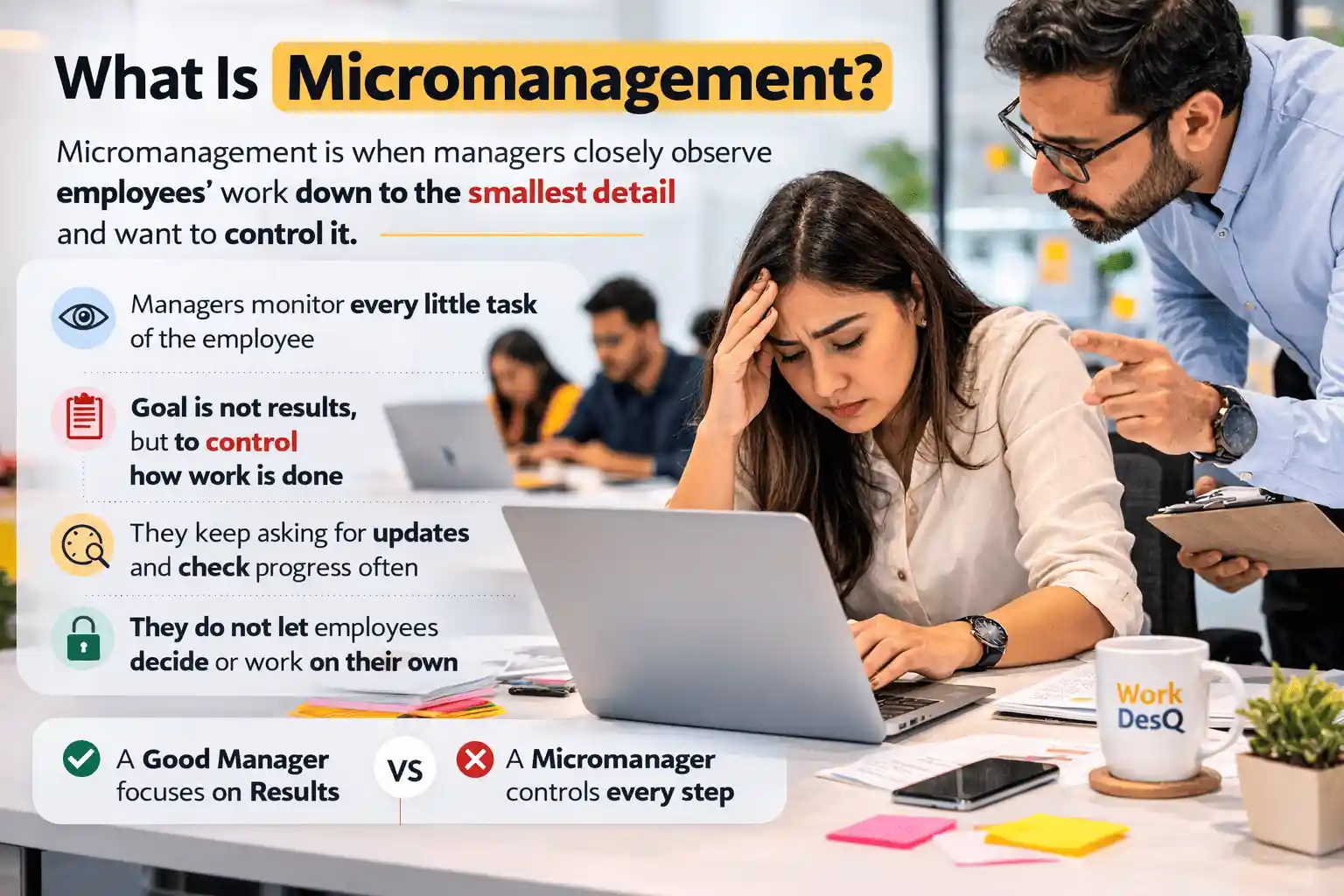
What Is Micromanagement?
To understand micromanaging examples, you need to understand what micromanagement is. Micromanagement is when managers closely observe employees’ work down to the smallest detail and want to control it.
A manager’s goal is not results; they monitor every small task of the employee to see if it is completed or not and how it is being completed. Many people also search for what is micromanaging. Both terms have the same meaning: keeping a close eye on the employee’s tasks.
A good manager focuses only on results, while a micromanager wants to control every step.
24 Micromanaging Examples at Work
We will share some common micromanaging examples you will see in every company
- Requesting manager updates every hour
- Rewriting employee work manually
- Rejecting employee decisions, no matter how small
- Monitoring employee work every minute
- Repeatedly disturbing employees during work
- Checking employee emails to see what they are sending
- Checking employee mouse movements every minute
- Requesting multiple reports for the same job
- Rejecting employee work without a valid reason
- Managers giving step by step instructions for simple tasks which wastes time
- Keeping employees busy with too many useless meetings
- Repeatedly checking completed tasks
- Controlling employee communication
- Copying the manager on every small thing because it is the manager order
- Repeatedly checking screen recordings
- Rejecting employees’ ideas, no matter how good they are
- Explaining short breaks to the manager because it is the manager order
- Repeatedly asking questions on the same project
- Assigning work and then taking it back without reason
- Asking the manager’s permission before speaking in a meeting
- Making detailed daily logs
- Highlighting small mistakes
- Employees can’t make their own decisions
- Managers want to do all the work themselves rather than have the team do it because they don’t trust them
These are micromanaging examples that can frustrate employees and sometimes lead to burnout
Top Warning Signs of a Micromanager
A manager is slowly becoming a micromanager. Here are some early signs you should know
- Never trusting their team. They always feel the team cannot do the work so they start doing it themselves.
- Shouting at employees for every small mistake.
- A manager monitors employee activities in the office such as who they are talking to and why they take many breaks instead of focusing on their work.
- Firing an employee without a valid reason or illegally
- Requiring an employee to provide a warning letter due to a personal matter. This is where the manager is being unprofessional.
- The manager doesn’t talk to their team or accept their ideas.
- Complaining about employees to the business owner over every little thing.
- Not providing support or training to employees when needed.
These are some of the top warning signs that a manager is unprofessional and getting personal. This is something that should be avoided in any company. A micromanager can never improve the performance of the team.If these patterns start to appear, then micromanagement is already impacting the team.
Hidden Damage of Micromanagement
Many managers think strict supervision will improve employee performance but in reality this is not true. It reduces employee engagement and can create serious problems if micromanaging examples happen in the company. Let’s talk about some hidden damage
- Employee confidence decreases
- Productivity decreases
- Employee creativity wanes
- Employee turnover increases
- The workplace transforms into a toxic atmosphere
Why Do Managers Start Micromanaging?
There are many reasons why managers start micromanaging but here are some common reasons
- Lack of trust in employees
- Fear of mistakes or failure
- Pressure from senior management
- Lack of delegation skills
- Need for control over work
- Lack of management experience
- High performance expectations
- Difficulty letting go of tasks
- Previous negative work experiences
- Unclear roles and responsibilities
- Concern about project results
- Believing that their way is the best
How Managers Can Stop Micromanaging

If managers understand micromanaging examples they can improve their leadership. They can eliminate micromanagement by taking a few steps
- Focus on results, not on employees’ daily activities.
- Build trust with employees.
- Give honest feedback on their work, rather than based on personal matters.
- Give employees the freedom to make decisions.
- Share your ideas and theirs with employees.
- Stop interrupting unnecessarily.
- Reward employees for their performance, which will motivate them to do better.
- Provide training and support where employees need it.
When a manager monitors employees’ work without micromanagement, employees improve their performance.
How WorkDesQ Remove Micromanaging
When a manager uses WorkDesQ employee work monitoring tool they do not need to check employees every minute. This helps managers build trust with their team and remove unnecessary micromanagement, and you won’t see as many micromanaging examples
Let’s talk about the features managers use to remove micromanagement
- Automatic Work Tracking
- Clear Productivity Reports
- Real-Time Work Visibility
- Better Transparency
Our WorkDesQ software is also in demand because many companies ask employees to work remotely or in hybrid work which can be difficult to track. Our software makes it easy to track employee work without micromanagement.
Last Lines on Micromanaging Examples
Even today you can find micromanaging in many companies where employees feel stressed. If an employee is stressed, they will not be able to work properly, which will lead to a decline in their performance and that of their team, and the company may suffer losses. Micromanaging will never lead to high performance by employees; instead, they will consider leaving the company.
In companies, a manager plays the biggest role in micromanagement, but if they work without becoming a micromanager, their team will perform well, and trust will also be built with them, and the atmosphere of the workplace will become much better.
We hope you have understood what micromanaging is and what micromanaging examples are.