See Productivity in Real Time.
Monitor employee activity, track work hours, and improve team efficiency with powerful insights.
If your business is running 24/7 then you may face many challenges. Whether you run a small business or a large company you need support staff all the time. An 8-hour shift schedule for 7 days a week is a shift planning system, it can be divided into morning, evening and night shifts.
A good 8-hour shift schedule for 7 days a week is not just about covering shifts. It is about fair shift rotation, weekly off and giving proper work life balance. Good planning reduces overtime, employee conflicts and business interruptions.
Today most companies use Excel templates and employee scheduling software that manage attendance, shift planning and employee work hours.
What Is an 8-Hour Shift Schedule for 7 Days a Week?
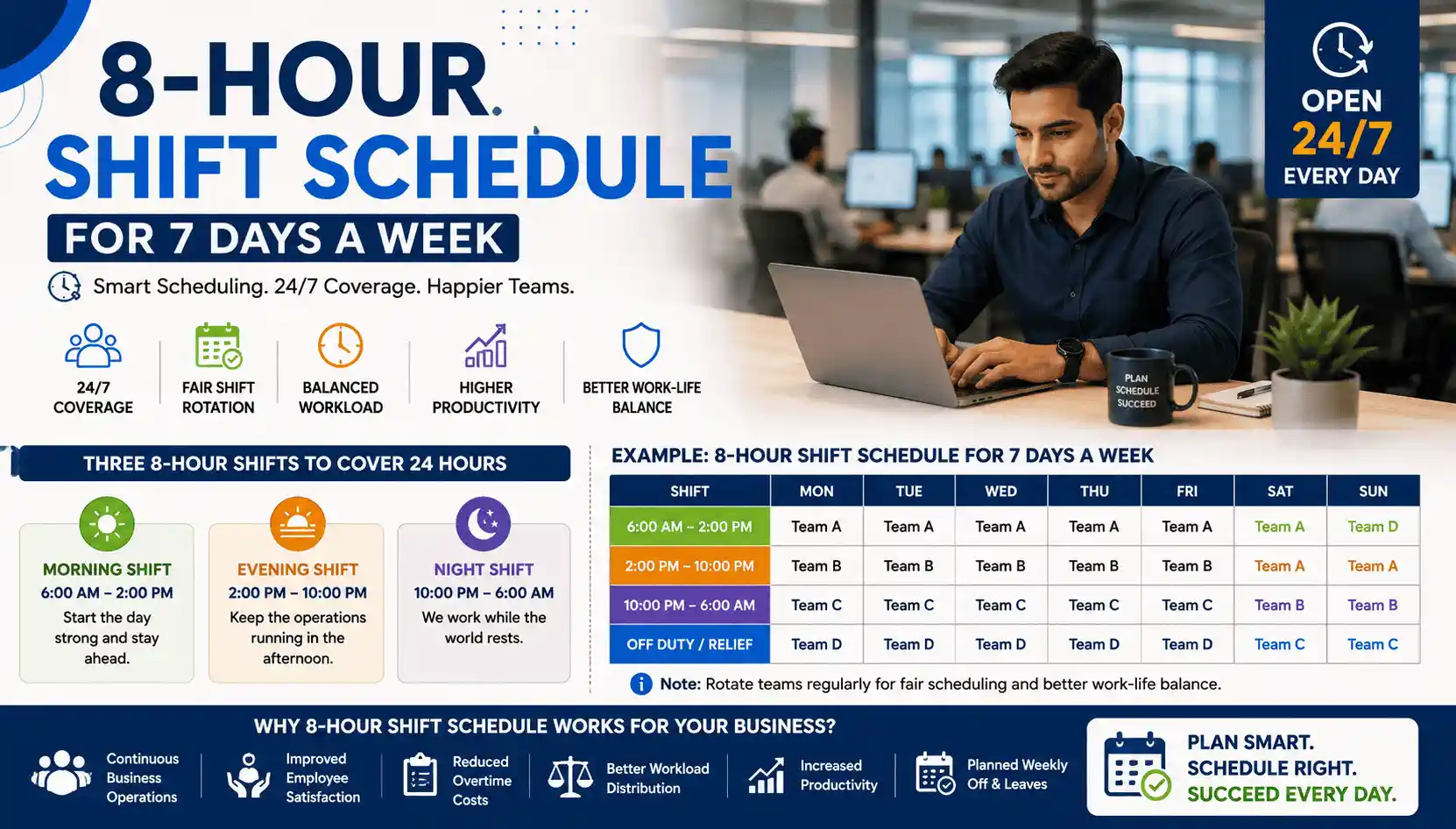
An 8-hour shift schedule for 7 days a week is a staffing model that is designed to help a business run without interruptions. Instead of following a Monday to Friday schedule employees are assigned 8-hour shifts to keep business running all time.
This business model runs every day and helps divide the workload equally among employees and it also ensures that standard full-time working hours are maintained.
How Does an 8-Hour Shift Schedule Work?
To cover 24 hours companies usually use three shifts like
- Morning shift – 6AM to 2PM
- Evening shift – 2PM to 10 PM
- Night shift – 10PM to 6AM
A company employee works 40 hours a week and 5 days or 8 hours in a day. That is why a company needs to create multiple teams and rotate employee shifts.
Note– This is only an example. You can plan shifts according to your company policy.
Example of an 8-Hour Shift Schedule for 7 Days a Week
Below is a simple example of a four-team fixed schedule. Team A, B, C work the day shift and Team D works as a relief team that covers days off and keeps the business running.
| Shift | Monday | Tuesday | Wednesday | Thursday | Friday | Saturday | Sunday |
|---|---|---|---|---|---|---|---|
| 6 AM to 2 PM | Team A | Team A | Team A | Team A | Team A | Team A | Team D |
| 2 PM to 10 PM | Team B | Team B | Team B | Team B | Team B | Team A | Team A |
| 10 PM to 6 AM | Team C | Team C | Team C | Team C | Team C | Team B | Team B |
| Off Duty | Team D | Team D | Team D | Team D | Team D | Team C | Team C |
Note – This is the only example of a fixed schedule and if you want to run long term you have to rotate teams for better work life balance and ensure the same team does not always work on the weekend.
How Many Employees Do You Need for a 7-Day Shift Schedule?
When you plan a workforce shift schedule this is the most common question in your mind.
1 week = 168 total working hours
If one employee works 40 hours a week then the calculation is like this
168 ÷ 40 = 4.2
That means if you are running a business 24/7 then you need at least five employees. If requirements of 10 employee in a shift, then total headcount must between 42 to 50 employees so that 24 hours schedule manage smoothly.
Best 8-Hour Shift Rotation Patterns
You can use rotating shift schedule for maintaining fair scheduling like
- Fixed Shift Pattern
In the fixed shift pattern employees always work the same shift for examples team A is works permanently in morning shift, team B works permanently in evening shift and team C works permanently in night shift
- Rotating Shift Pattern
After a fixed time the employee’s shift changes like in 1 week of the starting month morning shift, next week evening and last week night shift. It also can be if employee working in morning shift, then it might be chance employee would work next week in a night shift
- Forward Rotation Pattern
This rotation follows a pattern like morning to evening then night shift and most companies use this pattern because it is easier to adjust to new shift timings and it also maintain work life balance
- Backward Rotation Pattern
In the backward rotation shift, employee shifts change from night to evening then morning. It’s also difficult because shift timing change in reverse direction
- Relief Team Pattern
The relief team works as a backup team when an employee is on leave, weekly off or absent then the relief team covers that shift.
This pattern helps the business run without any interruption 24/7
Industries That Commonly Use an 8-Hour Shift Schedule
An 8-hour shift schedule is commonly used in businesses that need to work through today and this shift schedules company can divide employees in the shifts
Healthcare
Hospitals, clinics and emergency care centers need 24/7 staff and doctors, nurse and supports staff works in different shifts so that patients get proper care
Manufacturing
Factories run for long hours and 8-hour shift schedule help workers to take rest and running production continuously
Call Centers and Customer Support
Call centers run 24/7 and by using proper shift schedule companies can make someone is always to attend customer enquiries
Hotels and Hospitality
Hotels never close because front desk, housekeeping, security and room service staff need to be available all the time that is why 8-hour shift schedule is very common
IT Support and Data Centers
Most companies need technical support at all times and IT support team works in a shift timing so that system issue can solve quickly and business service running without any interruption
Benefits of 8-Hour Shift Schedule for 7 Days a Week
- Better work life balance
Employees get enough time to spend with their families after an 8-hour shift and personal time. This helps maintain a good work and personal life balance
- Less employee tiredness
An 8-hour shift is better than longer working hours is more comfortable because employee less feel tiredness and focus better on work
- Continuous business operations
With the help of morning, evening and night shift that help business without interruption or one shift ends then next shift starts
- Easier Shift Planning
Managers can easily plan weekly and monthly shift schedules and assigning employees easily into different shifts
- Fair shift rotation
If company follow rotating shift, then employee not getting only night shift and every employee get equal chance to work in all shifts
- Less scheduling problems
Good shift management helps reduce the chance of missed shifts and work operation smoothly
How to Create an Effective 8-Hour Shift Schedule
Understand Your Staffing Requirements
First you have to check how many employees you need in all shifts because every have enough staff so that workload manage easily
Give Employees Fair Shift Rotation
If you are using a rotating shift then divide employees equally into shifts and it maintain fairness to everyone
Schedule weekly off
It is important to give regularly weekly off because continuous work leads to burnout
Avoid Unnecessary Overtime
If it is not needed do not schedule employees for overtime because sometimes overtime leads to reduce productivity
Keep Shift Timings Consistent
Try to keep the same shift timings in every week because fixed timings help employee plan a day
Be Ready for Employee Absences
Sometimes an employee is absent without notice or without approval then so be ready for that situation and make backup plan
Share the Shift Schedule in Advance
Share the work schedule one week in advance so they prepared for new shift timings
Monitor Attendance and Working Hours
Monitor employee attendance regularly and check shift coverage so that you can identify earlier issues
Use Shift Scheduling Software
If you are managing multiple shift employees then you must use shift scheduling software because it helps you in planning, attendance tracking and leave management
Common Shift Scheduling Mistakes You Should Avoid
If you are creating an 8-hour shift schedule for 7 days a week then you should avoid these mistakes because small mistake can be risky for your company and its effect daily operations
- Schedule same employee night shift regularly
- Ignoring employee rest time
- Do not check employee availability
- Totally depending upon overtime
- Change employee shift in last minute
- Do not divide workload equally into employees
- Not making backup plan
- Not reviewing shift scheduling regularly
Free 8-Hour Shift Schedule Template
| Employee | Monday | Tuesday | Wednesday | Thursday | Friday | Saturday | Sunday |
|---|---|---|---|---|---|---|---|
| Emp 1 | Morning | Morning | Morning | Off | Morning | Morning | Off |
| Emp 2 | Morning | Off | Morning | Morning | Morning | Off | Morning |
| Emp 3 | Evening | Evening | Off | Evening | Evening | Evening | Off |
| Emp 4 | Off | Evening | Evening | Evening | Off | Evening | Evening |
| Emp 5 | Night | Night | Night | Off | Night | Night | Off |
| Emp 6 | Night | Off | Night | Night | Night | Off | Night |
Shift timings are
- Morning shift – 6:00 AM – 2:00 PM
- Evening shift – 2:00 PM – 10:00 PM
- Night shift – 10:00 PM – 6:00 AM
Manage 8-Hour Shifts with WorkDesQ
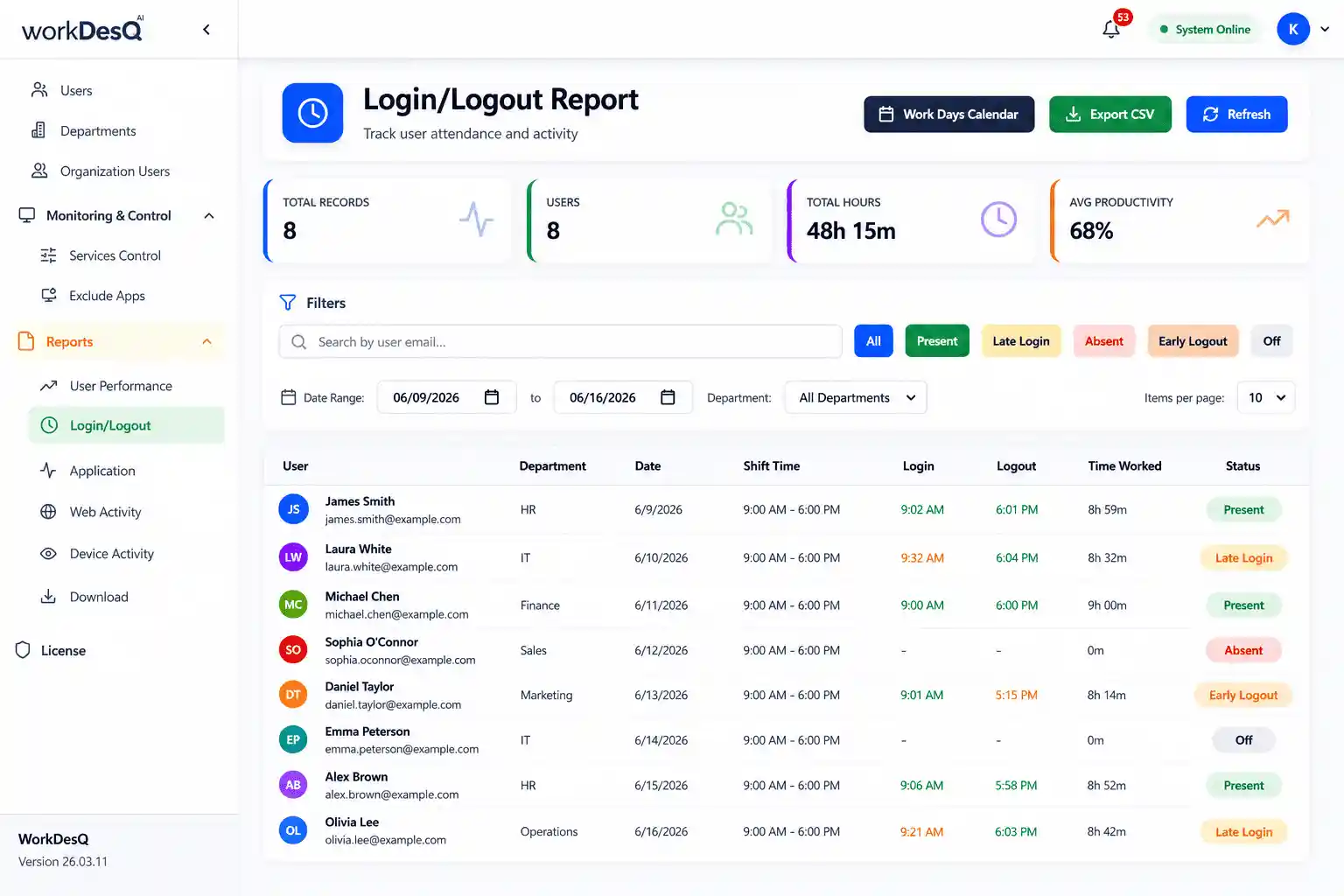
Without using software, you may lots of problems for managing multiple work scheduling but WorkDesQ helps you organize shift schedules like
Create Shift Schedules Faster
You can create and manage shift scheduling in one plan without using paper sheets. You can just enter the details one time.
WorkDesQ calculate automatically attendance tracking and work hours of employee so that you can easily check who is present or absent
Manage leave easily
When an employee submits a leave request through software so you can easily update shift schedule and that easy for making replacement plan
Reduce scheduling mistakes
In manual planning some double shift, missing shift or uneven issue happen and WorkDesQ help you out organizing to maintain balanced schedule
View Everything in One Place
When you use the software, you have no need to make different sheets you can view attendance, leaves, absent, present, late login and shift schedule in one place
Update shift anytime
Changes in business needs are very common, if you want to change employee shifts then you can change quickly without creating new ones from scratch.
Have questions about Managing Shift Schedule With WorkDesQ
Conclusion
An 8-hour shift schedule for 7 days a week is an effective method for running business without interruption. If you do proper workforce planning and choose a fair rotation pattern and use work schedule software and templates then you can reduce employee workload and reduce employee burnout risk.
A well-planned schedule process improves employee productivity and helps to maintain 24/7 operations smoothly.