Many managers think about which employee is performing well. They trust observation or annual reviews. But without measurable data reviewing employee performance becomes very difficult and mistakes happen. This is where employee performance metrics become necessary
Employee performance metrics help companies to measure real productivity, work quality and overall performance. Instead of depending on assumptions, it is better to base decisions on measurable performance indicators.
When companies track employee performance metrics, productivity and accountability continuously improve. In this blog, we will explain:
- What are employee performance metrics?
- 15 real-life examples.
- The formula for measuring performance metrics.
- How to track employee performance.
- The best tools for automatically tracking performance.
What Employee Performance Metrics Mean
Employee performance metrics are indicators that measure employee performance and allow you to find their contribution to the company. These metrics can help clear up any doubts you might have about an employee performance like
- How productive is the employee?
- Is their work progressing well?
- What is their output rate?
- Are targets being achieved?
Instead of using guesswork, employee performance metrics allow you to convert guesswork into performance data. This makes performance evaluation fair and transparent.
Why Employee Performance Metrics Matter
Employee performance metrics are crucial for every company. They allow you to track employee performance on a real-time basis, and they offer significant benefits to the company. There are several key reasons why they are important:
First, employee productivity improves because when performance is visible employees perform better.
You can make decisions based on data because you have complete employee performance data.
Performance metrics help employees receive fair performance reviews, rather than relying on guesswork.
Employee accountability also improves because when there is tracking employees become more responsible.
15 Important Employee Performance Metrics Examples
These are the most commonly used employee performance metrics.
| Metric | How to Calculate | Example |
|---|---|---|
| Productivity Rate | Total work done / Total time | 50 tasks per week |
| Task Completion Rate | Tasks finished / Tasks given × 100 | 90% |
| Attendance Rate | Days present / Total working days × 100 | 96% |
| Quality Score | Correct tasks / Total tasks × 100 | 98% |
| Error Rate | Number of errors / Total tasks × 100 | 2% |
| Utilization Rate | Working time / Total time × 100 | 80% |
| Average Task Time | Total time / Total tasks | 30 minutes |
| Goal Completion Rate | Goals completed / Total goals × 100 | 85% |
| Response Time | Total reply time / Total requests | 5 minutes |
| Customer Satisfaction Score | Positive feedback / Total feedback × 100 | 95% |
| Revenue Per Employee | Total revenue / Total employees | $5000 |
| Absenteeism Rate | Days absent / Total working days × 100 | 3% |
| Overtime Hours | Extra hours worked | 10 hours |
| Employee Retention Rate | Employees stayed / Total employees × 100 | 92% |
| Efficiency Rate | Work done / Resources used | 20 tasks per day |
Different Types of Employee Performance Metrics
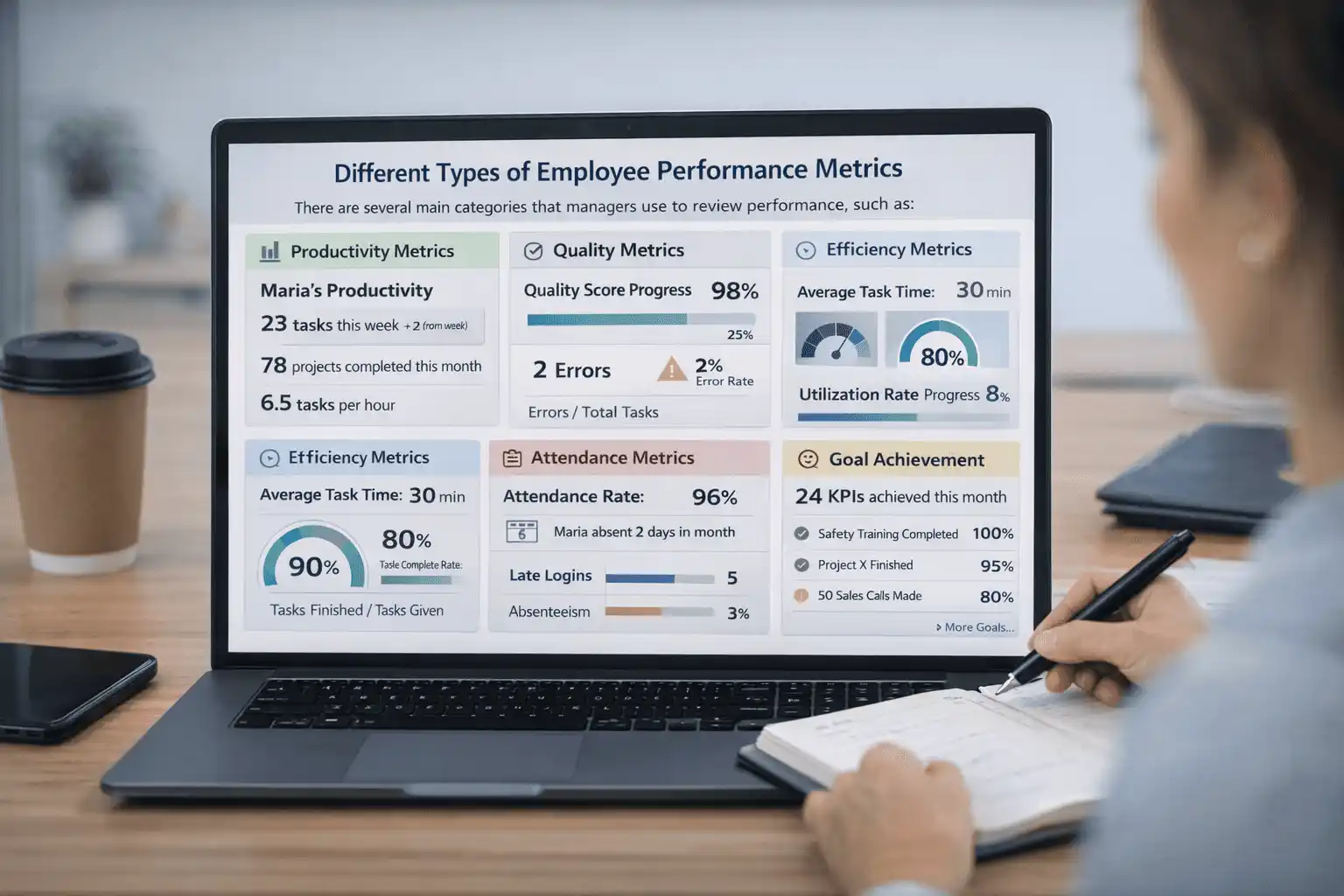
There are several main categories that managers use to review performance, such as:
Productivity metrics
Productivity metrics measure how much work an employee is completing. For example, if Maria is an employee, she might ask how many tasks she completed per day, how many projects she completed in a month, and what her output per hour is.
Quality metrics
In this case managers determine whether the employee completed the work and how well they did it.Managers check for errors in the employee’s work.
Efficiency metrics
These metrics provide the manager with data on how much time the employee took to complete the task.
Attendance metrics
These metrics provide managers with employee attendance data, allowing them to check their attendance rate, how often they were absent, and how many late logins they made. You can use our attendance tracking software to explore attendance metrics in more detail.
Goal Achievement
These metrics measure how far an employee has reached a target, such as:
KPI achievement rate
Goal completion rate
Sales target achievement
These are all categories of employee performance metrics that help managers review employee performance and ensure they have consistent data.
Employee Performance Metrics Formulas and Examples
Productivity Formula
Productivity = Total Output / Total Time
Example
50 tasks / 40 hours = 1.25 tasks per hour
Task Completion Rate Formula
Task Completion Rate = Completed Tasks / Assigned Tasks × 100
Example
45 / 50 × 100 = 90%
Utilization Rate = Productive Time / Total Time × 100
Example
32 productive hours / 40 total hours × 100 = 80%
These formulas help measure employee performance correctly.
Real Productivity Example Using Metrics
A manager at a SaaS company with 100 employees told us that employee productivity was low and deadlines were constantly being missed because they lacked visibility into employee performance.
When they used WorkDesQ’s tool to track employee performance metrics, they noticed within a month that:
Employee performance increased by 30%
Idle time decreased by 50 %
Deadlines started being met
They were able to identify performance gaps and improve workflow.
Steps to Track Employee Performance Metrics
- Set goals and tell employees they have to complete 40 tasks per week..
- Focus only on productivity and quality, not on guesswork
- Track employee activity, such as login hours and task completion.
- Compare the employee’s actual completed tasks with the tasks you previously assigned to determine the actual work completed.
- Give feedback and help improve employee performance by showing them their performance data.
Best Tool to Track Employee Performance Metrics
While we have already told you which tool to use to track employee performance metrics, let us explain why using WorkDesQ is beneficial because it does not require any manual work; everything happens automatically.
- Productivity is automatically calculated, whether in graphs or Excel format.
- Work hour data is automatically calculated, making it easy for you to calculate overtime pay for any employee. If you want to know how to calculate it in detail, we have a full blog on this topic, “How to Calculate Overtime Pay.“
- Attendance data is automatically calculated, making it easy for you to calculate it in Excel. You can download it in PDF format.
- It provides a real-time dashboard, and you can also check reports department-wise to see which teams are performing well.
Common Performance Management Mistakes
Some common mistakes performance management often makes when tracking employee performance metrics include:
- Tracking too many metrics
- Ignoring quality work
- Not sharing metrics data with employees
- Using metrics for personal use
When management makes these mistakes, the data is often riddled with errors, and employee performance does not improve.
. If you want to know in detail why performance management makes these mistakes, we have a detailed blog on “Why the Performance Management Process Fails.”
Performance Metrics Final Thoughts
Employee performance metrics play an important role in measuring productivity, efficiency and contribution. Companies that use metrics consistently grow and these metrics provide stronger operational control. Companies also build high performing teams by using metrics.
Performance metrics are used only to measure and improve employee performance, not for personal use.