See Productivity in Real Time.
Monitor employee activity, track work hours, and improve team efficiency with powerful insights.
Adaptive challenges happen in every workplace and these challenges cannot be solved with only expert advice or any fixed process. To deal with these challenges employees and leaders need to change the way they think, work and respond to new situations. Here are some common examples of adaptive challenges in the workplace
- After a company merger employees struggle to adapt to a new culture
- Trust and morale go down after a leadership change
- Huge gap between company values and daily workplace practices
- Teams struggling to accept increased accountability
- Employees continue using outdated technology
- Facing difficulties in continuous improvement
A common leadership failure lies in the treatment of adaptive challenges by people as technical issues! Ronald Heifetz (leadership expert)
Knowing About Technical vs Adaptive Challenges
Many HR managers tussle after treating adaptive problems as technical issues.
Technical challenges often have known solutions. For instance: Here
- Updating of the payroll software system
- Troubleshooting a cybersecurity problem
- Installing a new Human Resource system
Adaptive challenges are different from these. Their examples include the following:
- Workers’ resistance to any such changes
- Forming trust after company’s restructuring
- Enhancing collaboration between various office departments
- Forming a more inclusive culture at your workplace
Technical issues require expertise, and adaptive challenges require behavioural changes.
Top 5 Most Examples of Adaptive Challenges in the Workplace
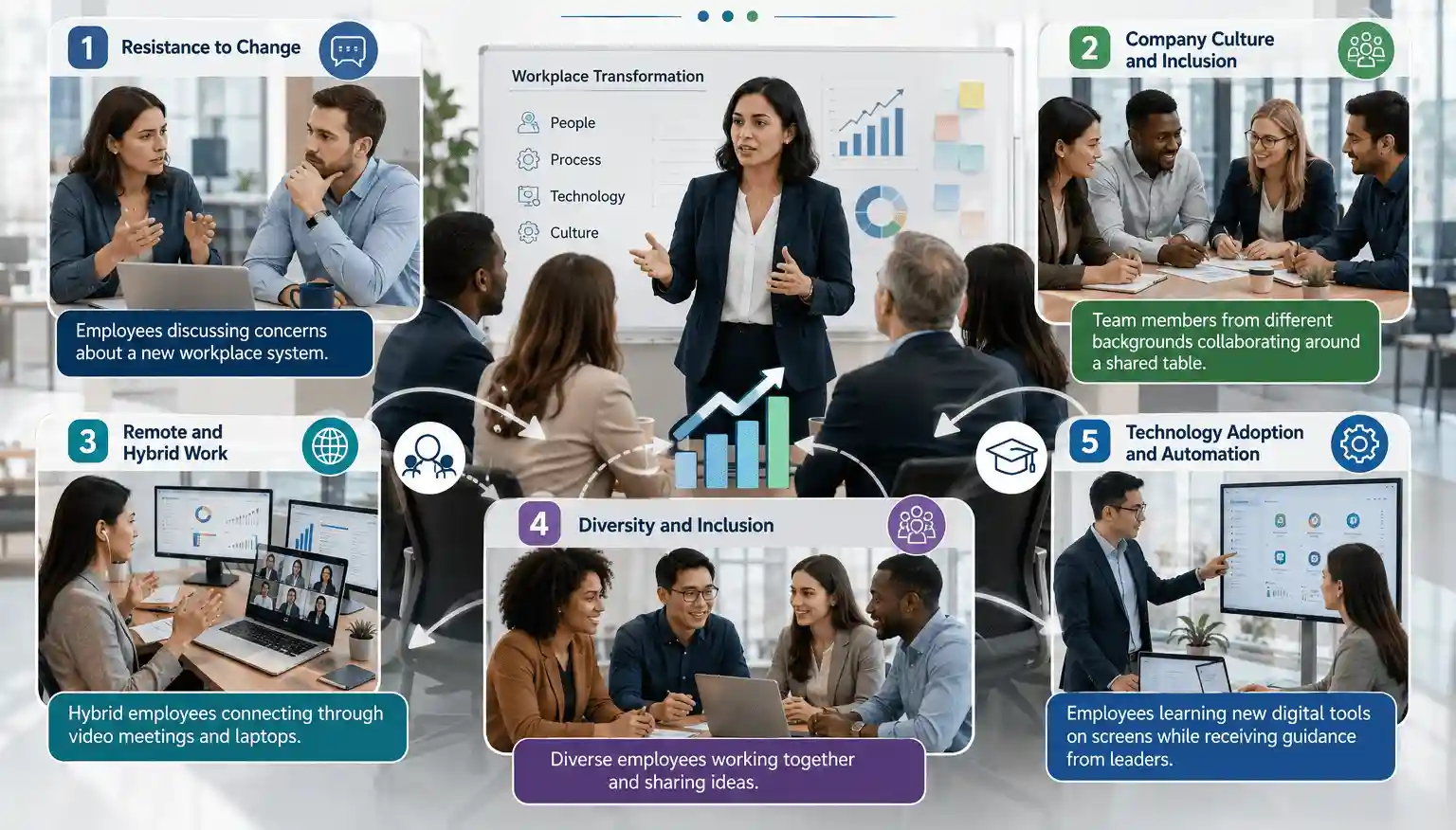
- Handling Resistance to Changes: One of the most prevalent examples of adaptive challenges in the workplace is when firms tend to introduce new systems/work strategies. Workers might be fearful of losing control, they might be fearing to learn new skills, or they could think of becoming less valuable for the organization. The real challenge isn’t this new system, it is actually the employees acceptance & embracement to change. HR people should interact clearly, listen to employees’ concerns, and also involve workers in any such transition processes.
- Forming a Solid Company Culture: Most firms tussle with organizational culture change. An organization might wish to shift from a conventional management style to a more collaborative one. But, the company’s culture is very much connected to current habits as well as beliefs. So, culture change demands consistent leadership behaviour, worker’s involvement, continuous interaction, and patience over time.
- Leading Remote & Hybrid Staff: The increase in hybrid work culture today has formed fresh workplace realities. Human resource teams, who earlier depended upon in-office interactions & supervision, now need to form trust-centric management approaches. Workers have to learn collaborations across multiple geo-locations. The company’s success demands new interaction habits, several accountability systems, as well as relationship-forming practices digitally.
- Enhancing Diversity & Fostering Inclusion: Firms usually launch diversity programs anticipating fast outcomes. But forming such an inclusive workplace needs workers to examine biases, change their behaviour patterns, & also develop new perspectives. Policies only can’t resolve such challenges. Long-term commitment as well as continuous learning are needed throughout.
- Adopting Automation & AI: Technology has been transforming workspaces. While incorporating AI might be a technical task, assisting workers adapt to such changes forms an adaptive challenge. Workers now have to gather new skill sets, accept new work responsibilities, overcome any uncertainties, and also develop confidence in working alongside technology-driven processes.
Adaptive Leadership Workplace Examples for HR Staff
HR leaders mostly play a significant role in adaptive leadership. Check out the following adaptive leadership workplace examples:
- Assisting workers to adjust after mergers or acquisitions
- Helping teams at the time of large-scale restructuring
- Supporting office managers to adopt fresh leadership styles
- Guiding about the initiatives for workforce transformations
In each of such cases, HR managers tend to focus on employees, their behaviour patterns, & long-term adaptation instead of quick fixes.
Adaptive Problem Solving at Work Really Helps!
Efficient adaptive problem solving at work tends to focus more on learning instead of controlling. Successful firms usually do the following to make this happen:
- Give room for open communication
- Collect workers’ feedback
- Evaluate small changes much before larger rollouts
- Making people learn from their mistakes
- Promote continual improvements
When workers feel more involved in solving such challenges, they tend to become much more willing to support such changes.
Examples of Adaptive Work in Modern-Day Firms
Present-day workplaces need workers to keep on adapting. Examples of adaptive work include the following:
- Staying updated with new digital tools available in the market
- Adapting to changing client expectations
- Working together with employees from different departments
- Managing flexible work timings & schedules
- Forming new leadership abilities
The Significance of Leading Through Adaptive Change
Office leaders, who tend to succeed during uncertainties, very well comprehend that employees require support throughout such a change journey happening around. Efficient business leaders do the following things for leading through adaptive change:
- They listen very attentively to workers’ queries
- They really encourage experimentation
- They try to build trust inside teams
- They tend to communicate honestly
- They try creating psychological security too
Instead of giving out all the responses, they try to guide people toward finding solutions themselves, together.
To Conclude
The best examples of adaptive challenges in the workplace tend to show that most organizational issues are actually staff-driven challenges, and not process difficulties. Whether you are dealing with company culture shifts, hybrid work environments, diversity initiatives, or even the adoption of Artificial Intelligence, such adaptive challenges need continuous learning, constant collaboration, & behaviour changes too. HR leaders, who tend to recognise such challenges early, could help firms navigate uncertainties much more successfully and form solid, resilient teams.
So, are you ready to manage your workplace changes much more efficiently? Visit WorkDesQ and discover smart workplace management solutions, which will help your HR staff support easy adaptation, simple collaboration, & guaranteed organizational growth.