See Productivity in Real Time.
Monitor employee activity, track work hours, and improve team efficiency with powerful insights.
To calculate productivity per employee, divide your total output by the total number of employees or total hours worked and this metric helps you understand how your team is performing during working hours.
By knowing how productive each employee is you can make better decisions for employees and the company. It does not matter whether you are handling a small team or a large team. Understanding per employee productivity helps identify problems and areas that need improvement.
In this guide you will learn
- How to calculate productivity per employee using formula
- What are the common mistakes made while calculating per employee productivity
- How to improve productivity
Managers can easily understand what teams do during working hours, which areas need improvement and which decisions are good for the business.
Why Per Employee Productivity is the Backbone of Businesses
Worker productivity actually refers to the amount of work any working professional finishes within a stipulated time period. When firms have a clear understanding about these productivity levels, the business owners can enhance processes, cut down on the time being wasted throughout the day, & eventually accomplish better outcomes. Measuring productivity is highly crucial for businesses as it helps in the following ways:
● Recognize top performers and identify chief contributors.
● It streamlines processes to enhance work efficiency.
● Set clear cut, realistic targets and performance expectations.
● Catalyze business growth & profitability.
How to Calculate Productivity Per Employee: An Easy Formula
An easy way to figure out how to calculate productivity per employee is to use this simple formula as follows:
Productivity Per Worker = Total Output ÷ Number of Workers in the Office
For example:
A firm generates around ₹10,00,000 in a month with ten employees.
₹10,00,000 ÷ 10 = ₹1,00,000
Each worker contributes an average of ₹1,00,000 in the company’s revenue.
This gives a quick snapshot of overall workforce performance.
Determining Accurate Individual Outcomes
A lot of business units intend to calculate individual productivity for understanding each worker’s contribution towards revenue. For instance, if a worker completes 200 customer support tickets in one month, his productivity could be compared against monthly expected targets. Such an approach makes it simpler for the managers to evaluate how much training is needed further and how to give rewards to high performing people fairly.
Checking Work Hours for Measuring Productivity with Accuracy
Another helpful option is the working hours calculation per employee. This particular formula is as below:
Employee’s Work Productivity = His Output ÷ No. of Hours Invested
Let us discuss a typical case: A worker tends to produce approximately 100 units in around 50 hours.
So, 100 ÷ 50 = 2 units in an hour
This gives a clear picture as it shows the actual time spent on certain tasks while working.
Key Metrics to Measure Productivity Per Employee
- Check how much work an employee completes in a given time
- Measure task completion rate
- How much time they use to complete a task
- Check revenue per employee
- Use feedback scores to understand quality of work
- Attendance and active working time
If you carefully check all these points, you can easily calculate productivity per employee. If you want to know how to measure productivity without any manual methods, then you can also sign up.
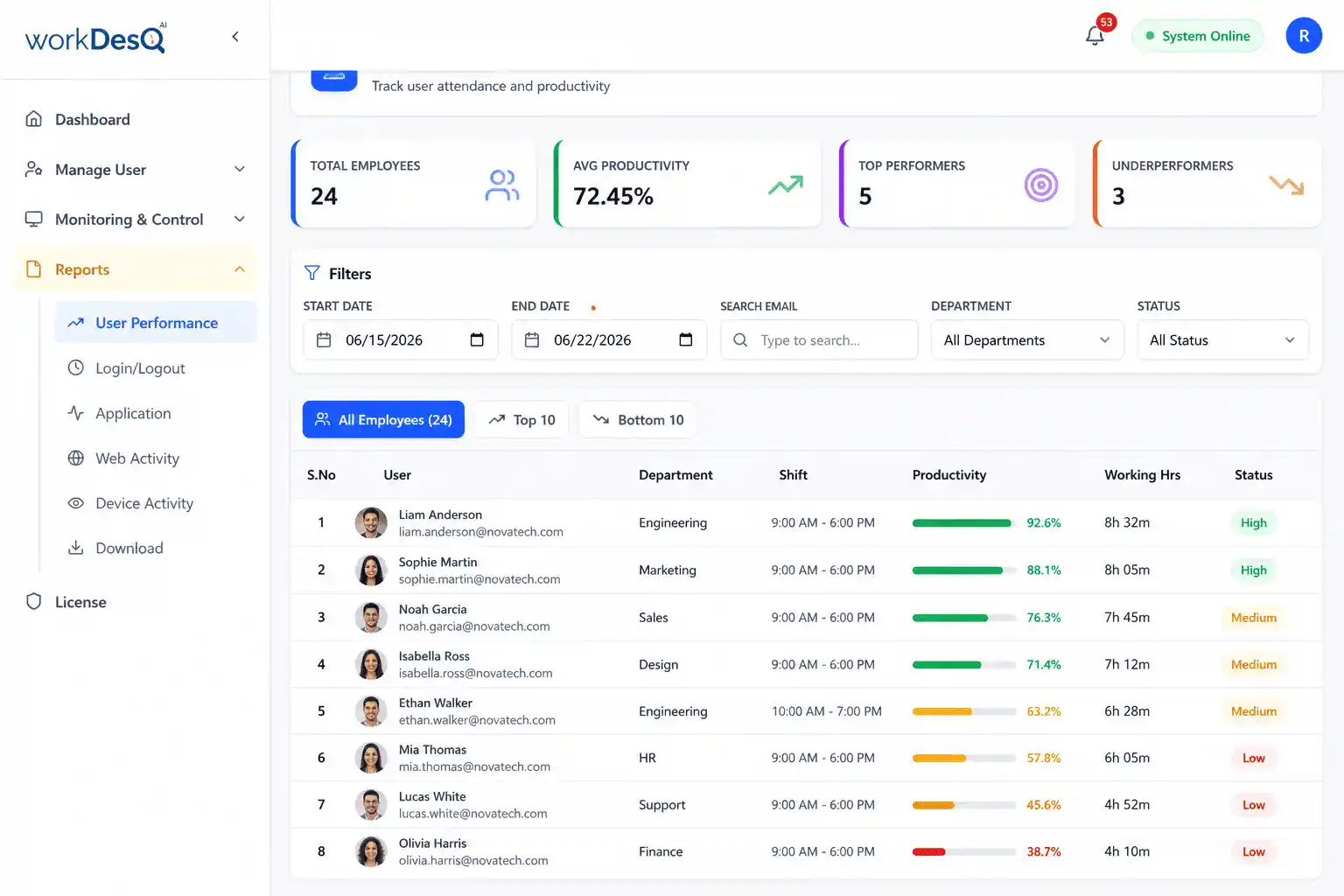
Sign up today with WorkDesQ and track Per Employee Productivity
Real Examples Showing How Firms Are Calculating Output Per Employee
Calculating output per employee is specifically helpful in the manufacturing sector, customer service domain, as well as for sales teams across different verticals.
For example:
A factory tends to produce somewhere around 5,000 products with 50 workers.
So, 5,000 ÷ 50 = 100 products by each worker
This figure helps managers a lot in comparing performances over time and identifying the room for improvement further.
How to Measure Average Productivity Across Different Teams
Tracking average productivity per employee helps businessmen know about the overall workforce performance.
The formula to calculate this is given below:
Total Output of the Company ÷ Total No. of Workers
The simple metric allows firms to do the following:
● Compare performances across various departments.
● Monitor growth trends and analyze them.
● Enhance workforce planning as well as resource allocation.
● Identify performance gaps and improvement opportunities.
Regular tracking helps managers pick better staffing choices as well as make more efficient operational decisions.
Key Mistakes You Must Not Make
While figuring out how to calculate productivity per employee, one must avoid such common mistakes as given below:
● Evaluating only quantity and not quality.
● Monitoring a lot of metrics together.
● Setting unrealistic productivity goals & expectations.
● Neglecting employee well-being and engagement.
● Failing to regularly review productivity & analyse data.
A well-balanced approach usually provides the most accurate outcomes.
Summary with Next Steps
Knowing how to calculate productivity per employee aids businessmen to boost performance, enhance efficiency, & make pick choices. Whether anyone tends to use revenue, tasks finished, or hours worked as the measurement metrics, regular productivity monitoring gives great insights into workers’ performance.
By merging productivity with efficiency metrics, firms could form solid teams to achieve long-term business success.
Do Not Miss This!
Are you searching for best workforce management solutions with 100% accurate productivity insights? You must visit WorkDesQ for streamlining your business operations, track employees’ performance, & build the teams that work much more efficiently.