Management is not just about assigning tasks to employees. A big part of the workplace is discipline and fair decisions with every employee, that too with transparency. But sometimes such a situation arises that discipline in the company starts deteriorating. Hence, it is very important to learn how to discipline an employee.
Teaching discipline to an employee is not punishment. It helps them understand and follow company rules. When employees follow discipline the workplace becomes organized and respectful. Discipline helps employees understand their duties and improve their work behavior. It also builds responsibility and trust between employees and management.
If you want to maintain discipline in your company and create a professional work environment this guide will help you understand the right steps and best methods.
- Employee Discipline Process
- Examples of Disciplinary Action
- Disciplinary Hearing
- Disciplinary Documentation
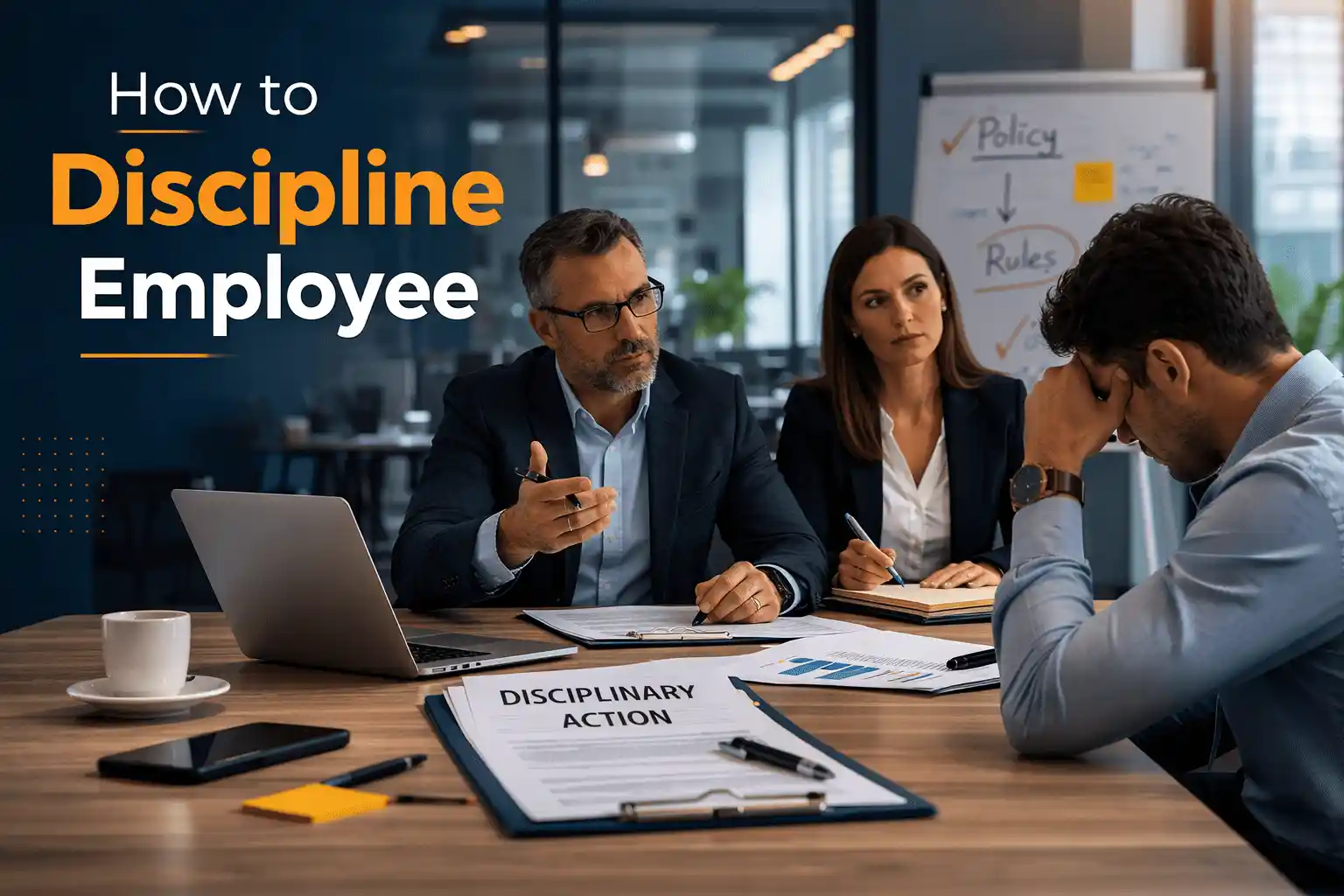
Understanding what discipline means in the workplace
Before understanding how to enforce employee discipline, it is important to understand what discipline is in the workplace. Employee discipline means taking appropriate action when employees violate company policies, do not meet performance standards, or commit misconduct. The main motive of disciplinary action is to improve the employee’s behavior, not to punish them.
Disciplinary action is meant to ensure fairness in the workplace. If discipline is not maintained, high-performing employees get demotivated.
Why employee discipline is important
Managers who know how to maintain employee discipline build a strong team and a good organization. Discipline protects both the company and employees.
- Protects workplace standards.
- Employees improve their performance through discipline.
- Reduces legal and complaint risk.
- Maintains team morale.
- Increases accountability.
So, knowing how to discipline employees is a critical part of leadership.
Progressive Discipline Model Gives a Fair Chance to Improve
Many companies use disciplinary action. This method increases discipline. However, if the employee’s behavior still does not improve, you can take these disciplinary steps:
Verbal warning
Written warning
Performance improvement plan
Final warning
Suspension
Termination
This method ensures fairness and gives employees multiple chances to change their behavior. You can teach discipline to employees by following these steps.
Step by step process to discipline an employee
When you discipline an employee you need to follow a structured process that avoids emotional decisions and ensures that the decision is fair to both the employee and the company.
Identify the problem. The reasons why an employee is not maintaining discipline will be visible in their attendance and performance reports.
Investigate before taking action, because you will never know the real reason unless you meet with them privately.
Always speak to the employee professionally, not for personal reasons. Always focus on the employee’s behavior, not their personality.
Real Workplace Disciplinary Action Examples
Disciplinary examples always help managers make the right decisions. Let’s explain them with some examples.
Attendance Problem
This is an important part of any HR professional or manager’s job is Improving employee attendance can involve taking disciplinary action like
Verbal warning
Issue a write-up for attendance
Final warning
Poor Performance
The problem arises when targets are not met.
You take disciplinary action
Performance assessment
Written warning
Policy Violation
The problem with this is when an employee violates company systems and you can take disciplinary action.
Written warning
Possible suspension
Misconduct
The problem arises when an employee behaves inappropriately in the workplace. In such cases, you may need to take disciplinary action:
Investigation
Disciplinary hearing
How to Conduct Disciplinary Hearings Properly
This is a process intended to fairly review employees with misconduct or bad attitude. This process provides both the company and the employee with an equal opportunity to present their side of the story.
1 Prepare First
Full preparation before the hearing is very important. The manager or HR should collect all important proof such as emails, attendance records, performance reports, warning letters and incident proof.
2 Inform the Employee in Advance
It is important to inform the employee before the disciplinary hearing. Explain the reason for the hearing, the date and time and what they need to do.
3 Give the Employee a Fair Opportunity
During the hearing, the employee should be given a full opportunity to explain their position. The manager should listen carefully to the employee and not interrupt.
4 Properly Document
After the hearing, it is important to properly document the final decision. This should clearly mention the hearing details, the employee’s explanation, and the final action.
In this way you will learn how to discipline a employee
Importance of Documentation
Documentation is an important part of disciplinary actions because it also helps reduce legal risks. You can mention:
- incident dates
- misconduct details
- warning letters
- employee responses
- meeting notes
Common Mistakes Managers Should Avoid
Managers should be aware of some common mistakes when implementing discipline, such as:
Delaying action
If you have identified an issue but ignore it, it could lead to a serious mistake later.
Making emotional decisions
Making decisions based on someone’s advice or personal issues could be a mistake. You should always base your decisions on data.
Making decisions without discussion, because unclear expectations always create confusion.
Not documenting or making decisions without keeping records can be detrimental to both the employee and the company, as the employee will feel unfair. This could expose the company to legal jeopardy.
If you don’t make these mistakes, you can learn how to discipline an employee effectively.
How to Discipline While Maintaining Respect
The purpose of discipline is not to damage dignity.
- Have private conversations
- Focus on behavior
- Listen to the employee
- Provide support
- Provide improvement opportunities
Respectful discipline yields better results
WorkDesQ’s Role in Fair Discipline
Any disciplinary decision requires accurate data. Our work monitoring software provides that accurate data, which works completely automatically. All you need to do is enter an employee’s details and install our WorkDesQ application on the employee’s laptop.
WorkDesQ helps you with
- Real-time tracking
- Productivity tracking
- Attendance tracking
- Idle tracking
With WorkDesQ, you can easily discipline an employee.
Key points to remember when disciplining an employee
Knowing how to discipline an employee is an essential responsibility of managers and HR leaders. Proper disciplinary actions protect performance standards and ensure workplace fairness.
Most importantly disciplinary action should be for improvement not punishment. Proper discipline does not damage employee relationships. It builds trust and improves performance. When these things work together in the right way employees achieve long term success.