See Productivity in Real Time.
Monitor employee activity, track work hours, and improve team efficiency with powerful insights.
Maintaining discipline in the workplace you have to set clear rules, communicate with them about expectations and lead by example. When employees understand company policies, receiving regular feedback and being treated fairly then they must follow workplace rules. You should address problems early and help them to solve problems.
You should follow some steps for maintaining discipline
- Make simple and easy to understand workplace policies
- Explaining expectations during onboarding and meetings
- You should also follow rules and set clear example
- Provide training for maintaining discipline at workplace
- Always appreciate strong performance
- Make document for any disciplinary action
When managers and employees communicate with each other and employees work excellently without taking pressure then these things are not just limited to discipline, it converts team productivity and improves overall business.
What is Discipline in the Workplace?
Discipline is a framework that includes company rules, behavior and management practices that align with company goals and values.
Discipline is not just about giving punishment to employees. Today many modern companies use discipline as a proactive plan. This helps employees understand expectations and creates a fair, respectful and healthy work environment.
Why Effective Discipline in the Workplace Matters
When companies not setting clear rules then it increases confusion between employees and managers but if you implement effective discipline, you got some important benefits like
- Promotes fairness
Employees work with confidence because they know rules are same for all workplace members
- Improve performance
Clear feedback explains employees that which area need to be improved and how to achieve company goals
- Protects team morale
If employee ignore their responsibility repeatedly then you should take disciplinary action and this action protect team morale
- Reduce legal risk
Making every document is part of discipline and documents prevent from any legal risk
Building a Culture of Discipline in the Workplace
A successful company does not need any formal punishment and the reason behind that company is to build a strong culture of discipline in the workplace. Let us understand how leaders create this culture
- Lead by Example
Managers also follow rules which they set for employees, if leaders come late in the meeting, then employees are likely to see punctuality as important
- Involve the Team
When deciding communication expectations then managers also take feedback in the decision making because employees more likely respect those rules which they contribute themselves to.
- Focus on the “Why”
Setting a clear rule is not enough its manager responsibility to explain clearly and tell employee purpose of rule
Traditional vs. Positive Discipline: What is the Difference?
| Factor | Traditional Discipline | Positive Discipline |
|---|---|---|
| Purpose | Corrects behavior through penalties | Improves behavior through guidance |
| Approach | Focuses on mistakes | Focuses on finding solutions |
| Manager Role | Acts as an authority who enforces rules | Acts as a mentor who supports employees |
| Employee Experience | Employees feel stress and fear | Employees feel respected and motivated |
| Communication | Mostly one-way communication | Encourages open discussion |
| Best Use Case | Suitable for serious misconduct | Best for everyday performance improvement |
Real Examples of Positive Discipline in the Workplace
Giving only a warning is not enough to maintain discipline in the workplace. The main concern is to understand the employee’s issue. Let us understand with some real examples of discipline in the workplace
Example 1 attendance issue
Situation – The same employee comes to the office late again and again
Positive discipline approach – Before issuing an attendance warning letter, the manager conducts a private meeting and understands the real reason for coming late. During the discussion, the employee explains that childcare responsibilities have affected the morning schedule. After understanding the problem, the manager gives a flexible work hour option.
Result – The employee works flexible hours without stress and follows the company working hour policy.
Source – Problems with an employee’s performance
Example 2: Declining Performance
Situation – A sales executive is continuously not meeting the sales target.
Positive discipline approach – The manager reviews performance data and then conducts a one-to-one meeting. After the discussion, both create a performance improvement plan (PIP) with clear goals, training sessions, and skill improvement.
Result- Within 60 days, the employee meets the targets and improves overall performance.
Source – Steps for Effective Performance Improvement Plans
Best Practices for Managing Discipline in a Workplace
You can manage discipline in the workplace through methods like empathy, clarity and by making proper documentation.
- Act Quickly and Privately
When you find a mistake, take action as soon as possible like by arranging a private meeting with the employee.
- Focus on Facts
You have to focus on facts and not judge based on emotions.
- Make clear policies
Explain company policies to all employees also when new employee onboarding your company you can share the handbook and policy document
- Treat everyone equally
Do not give special treatment to some employees, you should be fair with everyone
- Follow progressive discipline
Give verbal warning for the first mistake, if the same mistake happens again give written warning, after putting all efforts you should take disciplinary action.
- Reward positive behavior
Do not focus only on mistakes and when an employee does something well, give a reward
- Make healthy work culture
Encourage respect, accountability and teamwork
- Update company policies regularly
According to labor laws and business needs, you should update company policies from time to time
How WorkDesQ Helps Maintain Discipline in the Workplace
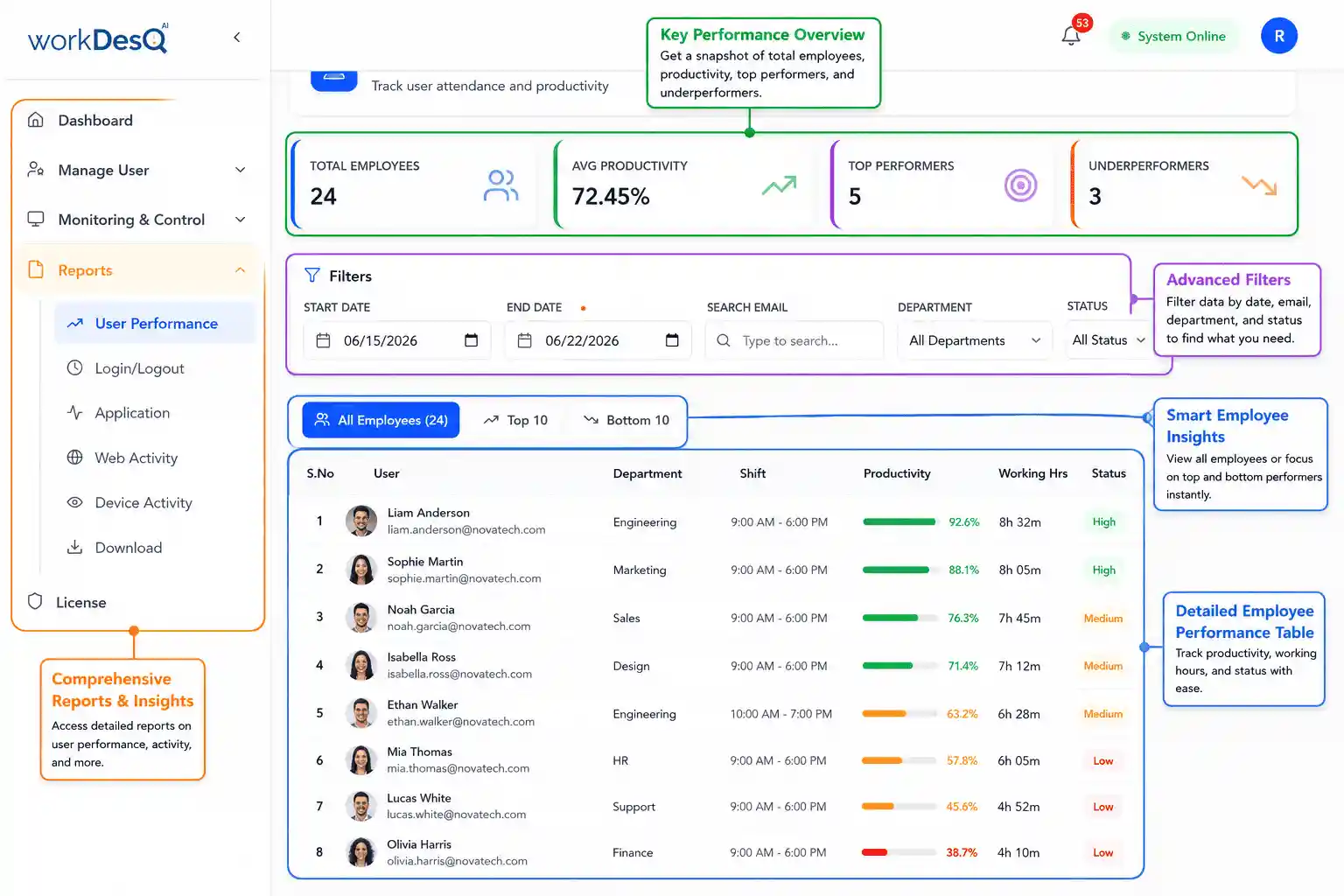
- Tracks work hours automatically
Attendance is an important part of discipline. WorkDesQ plays an important role by tracking employee attendance automatically, so employees follow the company attendance policy.
- Improves accountability
Every employee can check reports of work time, completed tasks, and productivity. When employees know that their work is tracked properly, they take more responsibility.
- Provide performance report
WorkDesQ generates detailed reports of active time, idle time, application usage, and screen activity.
- Create transparent work culture
When the company has employee activity data and employees can also check their data, there is less confusion between employees and management.
Employee Monitoring Software
Manage employee productivity and attendance easily with WorkDesQ
Final Thoughts
The main purpose of discipline is not controlling the employees or giving punishment, it supports growth and success and it protects from unhealthy workplace behavior.
When a company follows practical approaches like good communication, strong leadership example and positive discipline in the workplace then companies automatically develop accountability, trust and long-term growth.