See Productivity in Real Time.
Monitor employee activity, track work hours, and improve team efficiency with powerful insights.
As an HR professional or manager, you have to listen to employee complaints carefully and listen as a neutral person, check facts from both sides and maintain confidentiality, then take action according to company policy because it solves conflicts easily without damaging team culture.
In all companies’ employees work with each other that is why conflicts or complaints happen normally like misunderstandings between employees and create big issues because of harassment and toxic behavior, if you are not handling employees’ complaints in a proper way, then company faces problems like
- Low productivity
- Bad team environment
- Employee resignations
- Legal risk
That is why it is more important how to handle employee complaints about other employees effectively
Why Employee Complaints Happen in Workplace
Before solving problems, it is very important why complaints happen in the workplace. Here are some common reasons
- Poor communication between employees
- Lots of work pressure and employees feel stress
- Personality clashes
- Unfair treatment in workplace
- Gossip or office politics
- Company policy not clear
Types of Employee Complaints
Minor issue – small arguments over work or miscommunication, these issues are very common because every employee has a different way of thinking and have different work style and these problems are not serious can be solved by sitting together
Work related complaints – like he or she is not doing work properly you cannot depend on what one person says it is better to check facts like reports or completed task
Behavior issue – these complaints about how an employee behaves with other employees in the workplace like talking rudely and not respecting teammates. In this case employee needs a warning letter for bad behavior
Serious complaints– these are very important and sensitive issues like harassment and discrimination. These complaints can harm employees mentally and emotionally that is why you must handle these types of problem carefully and quickly
Step-by-Step Process to Handle Employee Complaints
- Do not ignore any complaint even it looks small
- Listen to the complaint carefully without judging
- Keep the matter private
- Collect full information about the complaint to check whether it is true or not
- Listen to the other side also in the same way
- Find the actual cause of the complaint like why this happened
- Decide right action, now take action based on situation
- Arrange a meeting if needed if both employees are okay, you can bring them together
- Keep proper records always write down what complaint was made, what was action made and what was discussed
- After solving this issue, do not forget to check again like ask the employee if everything is okay now
These are most main steps to handle employee complaints about other employees
Proven HR Tips to Handle Employee Complaints
- Stay fair and balanced
- Set clear rules in the company and ensure everyone follows
- Give training to managers for handling tough situation
- Create a safe environment so everybody can speak freely
- Do not take too much time taking action
- Do not take action with emotions always be professional
- Check complaint truth before taking action
Legal Responsibility in Employee Complaints
Handling employee complaints is not just about solving problem; it comes with some important responsibilities that include
- Keep employee safe at the workplace
- Protecting company reputation
- Following legal rules and company policy
How to Prevent Employee Complaints
Stopping employee problems is better than fixing problems. When the workplace runs smoothly, complaints automatically reduce. Here are some simple steps
- Keep communication clear so no one gets confused
- Have a strong leadership that guides team properly
- Give regular feedback so issues are solved early
- Give sessions on behavior, teamwork and company rules
When these are followed properly the team stays productive, positive and healthy
Example of Employee Complaint Handling
Example 1: Complaint About Rude Behavior
An employee comes to HR and says that his teammate talks very rudely and disrespects him in front of others.
How HR handles it– first HR listened carefully to both sides and HR gave a warning to maintain proper behavior and also suggested both employees to talk openly
Example 2: Complaint About Harassment
A female employee reports that a colleague is making her uncomfortable with personal comments.
How HR handled it – HR took the complaint seriously and kept it private, after investigation HR found , the complaint was found true then HR took strict action as per policy and warned the other employee
Mistakes to Avoid While Handling Employee Complaints
- Ignoring complaints for a long time
- Taking action on assumptions
- Taking sides too quickly
- Discussing issues in public areas
- Taking action without proof
- Not keeping proper records
If you are ignoring these mistakes, it can damage work culture and company reputation
Employee Complaint Policy
- How to submit a complaint
Employees can submit their complaint by email and an HR form
or directly talk to HR manager
- Time for action
The company should review the complaints within 2 or 3 working days and start taking action as soon as possible
- Keep it private
All complaints should be kept private, this builds trust and protect employees
Employee Complaint Policy
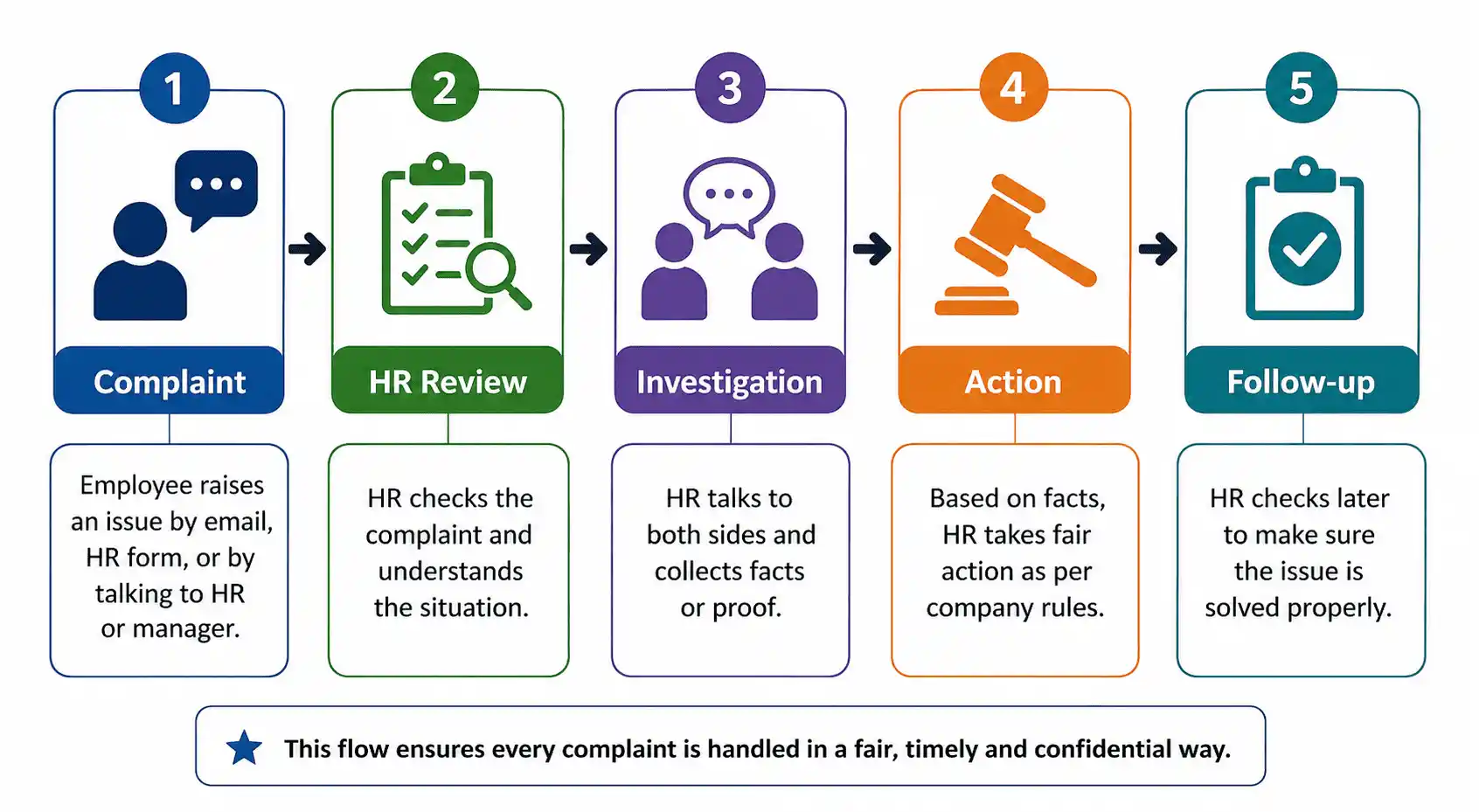
Complaint Handling Flow
Complaint → HR Review → Investigation → Action → Follow-up
How to Handle False Complaints
Do proper investigation
As HR your responsibility is to check before making decision
Give a warning to those who make false complaints
If you find that the complaint is not true then take strict action on that employee
Educate employees
Remind employees, complaint system is for real issues not for personal fights or revenge
Conclusion on Handling Employee Complaints
Handling employee complaints is not for deciding who is right or who is wrong. HR has more responsibility on their shoulders like
- Understanding the situation
- Be fair with everyone
- Take the right action at the right time
- Protect workplace culture
If you are handling employee complaints properly then you can convert conflicts into a strong team