See Productivity in Real Time.
Monitor employee activity, track work hours, and improve team efficiency with powerful insights.
Pros and cons of employee monitoring are not just limited to tracking productivity. Companies use monitoring to increase work visibility and secure the data, but on the other side monitoring may increase stress and reduce trust between employees and the company. It also creates confusion. Monitoring is not good or bad. It totally depends on how you implement it, like whether you want to use monitoring only for surveillance or to increase employee productivity and understand work patterns,
In this guide we cover
- Real benefits and hidden risk
- When monitoring fails
- What are best practices
How you implement monitoring without breaking trust or damage culture
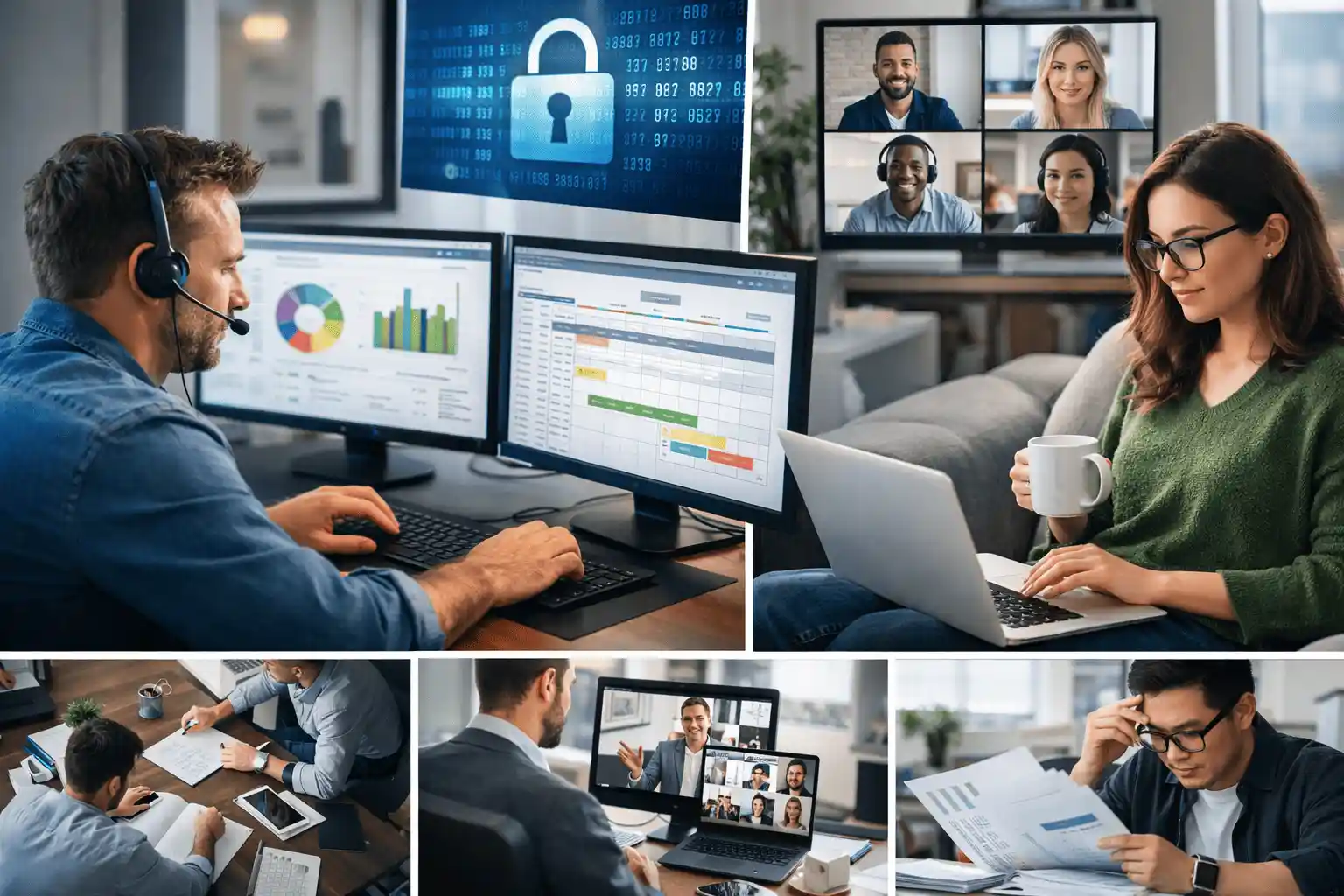
Pros of Employee Monitoring
If companies use employee monitoring tool in proper way it comes with many benefits like
- Better focus and discipline
Employees automatically reduce distractions because they know their work is being tracked
- Strong data security
Monitoring helps reduce data loss risks, like unauthorized access, which can be noticed early and handled quickly
- Data driven decision
Companies can make decisions based on data, instead of guessing. They make decisions according to insights
- Help in monitoring remote work
With monitoring, it becomes easier to understand how remote employees are working and on which project
- Fair performance reviews
When you collect employee work data it provides useful information and helps create transparency between employees and managers. You can make fair decisions based on actual work patterns instead of opinions.
Cons of Employee Monitoring
Monitoring also comes with disadvantages. It creates confusion among employees, like
1 Privacy concerns
Employees feel their privacy is at risk, like personal chats or emails
2 Trust issues
Employees start to feel that companies no longer trust them
3 Fake productivity
Employees use many methods to look busy instead of doing real work
4 Stress and Pressure
Continuous tracking makes employees feel burned out over time
5 Misleading data
Data without proper context can lead to wrong understanding and poor decisions
Impact of Monitoring on Employees
Employee monitoring can have both positive and negative impacts and this impact depend upon how companies use monitoring software.
| Positive Impact | Negative Impact |
|---|---|
| Clear work direction and it helps both the company and employees grow. | Feeling controlled because some managers track employees for some reasons |
| Faster task completion because employees know their productivity is being noticed | employees feel their every activity is being tracked, and then they feel disappointed with their job |
| Managers and employees can see how many goals are achieved | They fear making mistakes, and they feel hesitant to share new ideas |
| Regular monitoring helps employees focus on work time and daily tasks | Less open communication |
| Fair performance review because managers get actual work data | Work anxiety increases due to tracking |
Understanding When Monitoring Works and Fails
Employee monitoring works better when companies use it in clear and fair way. Employees should know what is being monitored, why using monitoring software and what data is being collected.
| Situation | When Monitoring Works | When Monitoring Fails |
|---|---|---|
| Communication | Employees are informed already before implementing | Not informed anything about monitoring |
| Trust Level | Employee monitoring helps to build trust between managers and employees | Employees feel uncomfortable and worried about work tracking |
| Data Use | Data is used fairly and for right decision making | Data is used for personal reasons and in the wrong way |
| Focus | Focus on important work activities only, not tracking personal information | Tracking everything after office hours |
| Results | Better productivity and teamwork | Lower morale and poor performance |
Best Practices for Ethical Monitoring
Transparent with Employees
Tell employees clearly what data is being collected and why management using and how data is being using.
Track only important things
Avoid monitoring everything and focus only on the work
Focus only on result
Measure only output, not user activity. If you want, you can monitor user activity. We have a detailed blog on this
Use data for smart work
Companies should use it to support employees and help them improve
Respect Boundaries
Companies should respect boundaries and employees should not be tracked outside work hours
How to Turn Monitoring Disadvantages into Advantages
1 From lack of trust to build clear communication
Good companies identify disadvantages of monitoring as soon as possible and try to fix them
Disadvantage – Employees feel the company does not trust on them
How you can fix this problem – Explain to employees in simple words what data is being collected or not
Result
employee clearly understand why companies tracking our work
2 From feeling watched to create normal work system
Disadvantage – Employees feel monitoring is like spying
Fix this problem –Make the same rules for everyone with no special treatment like no tracking after working hours
Result
Monitoring feels like a standard process not personal targeting.
3 From privacy issue to set strict limits
Disadvantage – Employees worry about personal data after implementation
Fix this problem – explain to them this tracking implemented only official work not personal details and your professional work data is secured
Result
employees starting work freely without any fear
4 Use micromanagement to use data for help
Disadvantage – Manager wants to control too much data after implementation
Fix this problem – Train managers to use monitoring only to find solutions and learn them how we can achieve our goals.
Result
Monitoring becomes a problem-solving tool, not a control tool.
Case Study Example
How a tech company improved productivity with employee monitoring
The tech company is a mid-sized company with 150 employees. The company noticed delays in projects and low visibility into work patterns
After implementation monitoring
- Introduced monitoring software for tracking project progress and work hours.
- Focused only on work tools and project activity, not personal chats or emails.
- Employees were informed in detail about what was monitored and why.
After one month, the results are
Productivity increased by 30 percent
Data security incident dropped by 40 percent
Employee satisfaction remained stable
Why Choose WorkDesQ for Employee Monitoring
When companies are looking to improve productivity and track work hours, WorkDesQ makes tracking simple and easy. Our software has many unique features
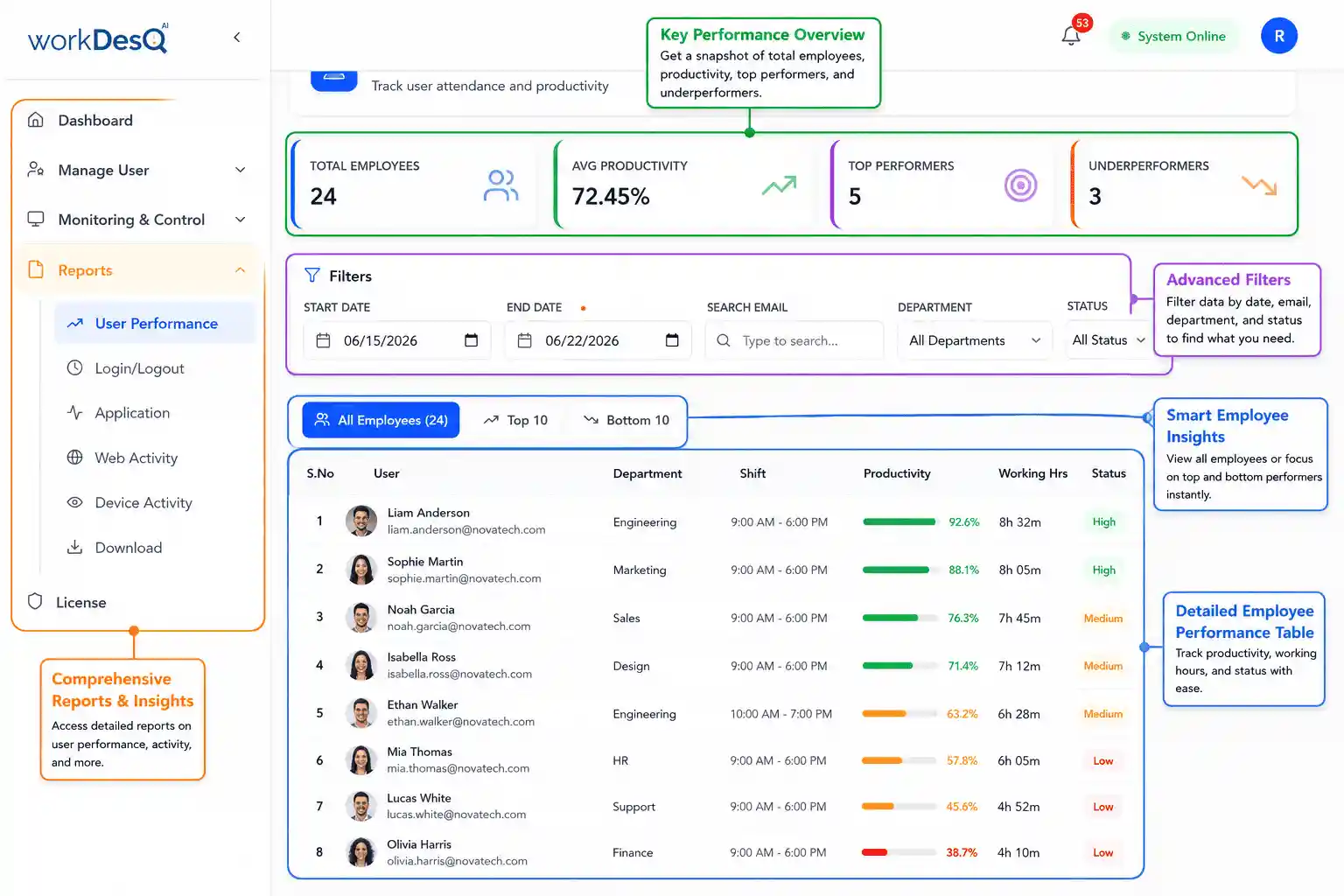
- Easy to use
- Track Work Clearly
- Protect Company Data
- Improve Team Productivity
- Flexible and Smart
Want To Improve Employee Monitoring?
Final Thoughts on Pros and Cons of Employee Monitoring
Pros and cons of employee monitoring do not depend on the tool. If monitoring is used in a good manner
- Productivity improves on regular basis
- Increase in work visibility
- Companies can make better decisions
If companies use monitoring for wrong purpose
- It can break trust between employees and companies
- It will increase stress levels
- Employees try to create fake productivity