Monitoring is not just a process but it is an important part of a company which depends on it. Monitoring helps you understand what is happening within tasks and teams. Failure to complete tasks properly can cause losses to the company and monitoring prevents this. That is why it is important to understand the types of monitoring.
In this blog, we will cover
- What is monitoring?
- What are the different types of monitoring?
- A definition of program monitoring.
- What are the types of monitoring?
- What are the three types of monitoring?.
- Real world examples.
- Steps to implement.
- Ethical guidelines.
What Is Monitoring?
It simply means tracking the work and reviewing the activities to achieve the goal and ensure that the work is being done properly. Monitoring is not spying it’s a process that gives you clarity about your employee work. Let us understand this with a few examples.
- A manager applies monitoring to ensure that project deadlines are being met.
- The HR team monitors whether employees are logging in and out on time and how much time they have left.
- The IT team monitors whether employees are accessing websites that could harm their laptops and reduce security risks.
It gives a clear picture of performance attendance and risk. You do not get all these three things in one software anywhere else but WorkDesQ is the first employee work monitoring software that gives you performance attendance and security risk information in one place.
Why Monitoring Matters Today
Previously there was only one work mode where employees had to come to the office and work. However, that is not the case today as companies now use remote work hybrid work or cloud systems.
Without monitoring,
Deadlines will be missed
Data breaches can occur
Productivity will continue to decline
Logins and logouts can be tracked according to flexibility
Monitoring is essential in the modern workplace to accurately track all of these things.
Program Monitoring Definition
It is a systematic process in which a project or initiative is continuously tracked to ensure that set objectives are being achieved. Let’s explain with some examples.
When a company launches a leadership program, program monitoring ensures
- whether employees completed the training
- whether skills improved
- whether long-term employee performance improved.
Program monitoring is an essential part of strategic planning.
Different Types of Monitoring
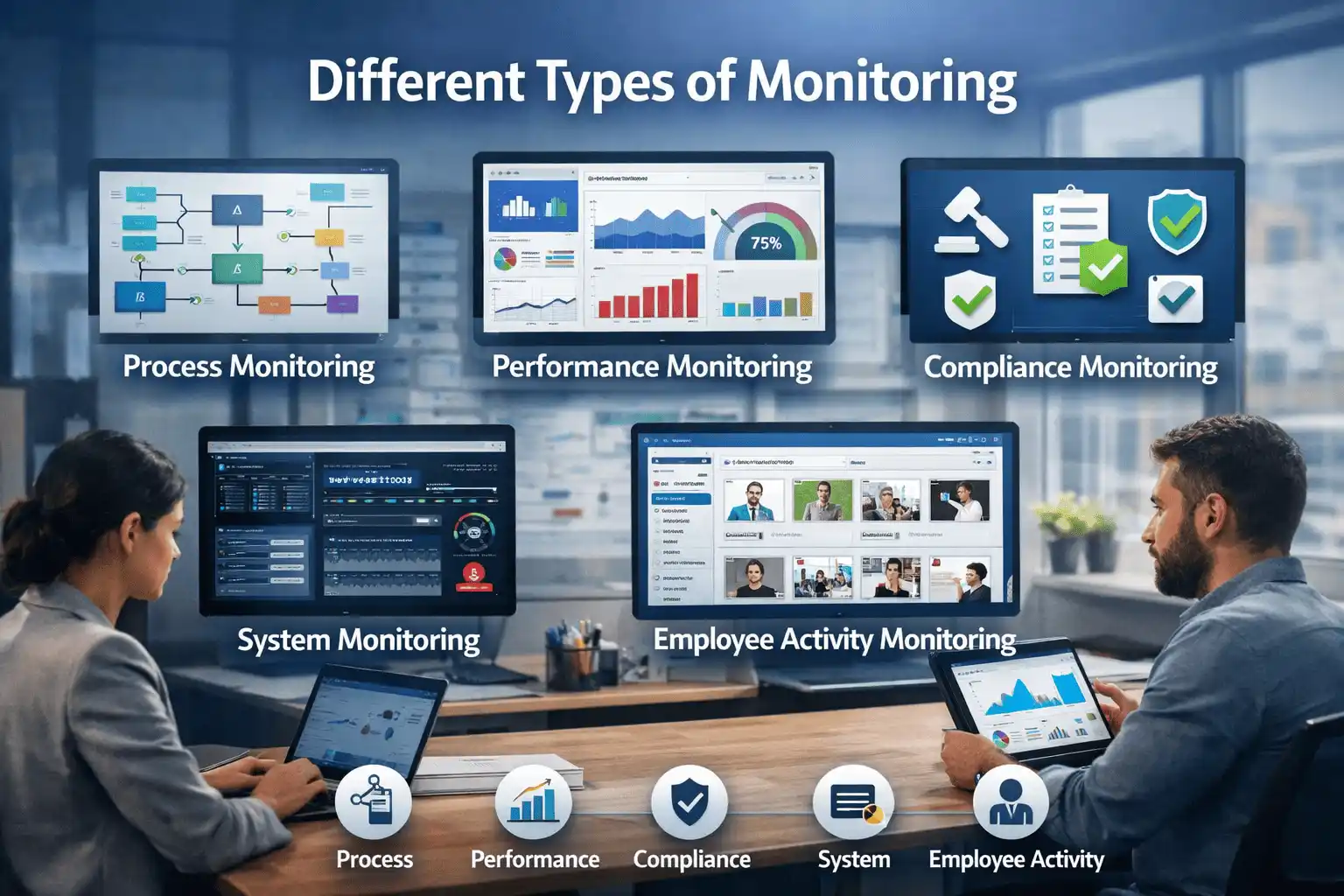
Not every company needs just one type of monitoring; they need different types based on their objectives. We’ll explain each type of monitoring below.
- Process monitoring
This focuses solely on how work is progressing in the office. This monitoring check workflow steps and efficiency levels.
- Performance monitoring
Performance monitoring always focuses on results, such as KPIs, tracking productivity, and output rates.
This is the most common type of monitoring in the corporate world.
- Compliance Monitoring
This monitoring is essential for every company. It ensures that legal regulations are followed, internal policies are not violated and industry regulations are complied with.
- System Monitoring
This monitoring monitors IT infrastructure for issues such as server issues, network stability, or application speed.
- Employee Activity Monitoring
This monitoring gives you a clear view of employee behavior such as login/logout time, application usage, idle time, or task completion.
While there are many types of monitoring, these are some of the most important types of monitoring that you will find in any company.
Summary Table: Types of Monitoring
| Type of Monitoring | What It Focuses On | Why It Is Used |
|---|---|---|
| Process Monitoring | How work is done (workflow) | To improve efficiency and avoid delays |
| Performance Monitoring | Results and output | To improve productivity |
| Compliance Monitoring | Rules and regulations | To stay legally safe |
| System Monitoring | IT systems and infrastructure | To keep systems stable and running smoothly |
| Security Monitoring | Security threats and risks | To prevent data breaches and attacks |
| Employee Monitoring | Employee activities & work patterns | To improve work management |
| Outcome Monitoring | Long term results and impact | To ensure business goals are achieved |
| Financial Monitoring | Budget and expenses | To manage money wisely |
Core Categories of Monitoring
The three main types of monitoring without which a company cannot function are:
- Process Monitoring
- Performance Monitoring
- Outcome Monitoring
Without these, a company remains at a loss because owners or managers have no idea what work is being done, what kind of work is being done, when the work is completed, and what benefit the company ultimately received from that work
How to Implement the Right Type of Monitoring
How to implement proper monitoring can be a bit confusing for a manager or company owner. The answer is, follow these steps and implement proper monitoring the right way.
- You need to clarify why you’re monitoring and what you want to measure
- You need to decide which monitoring method is best based on your objective
- You need to set KPIs and define measurable goals.
- Decide a review cycle, such as when to review: weekly, monthly, or daily
- Once you’re ready for monitoring, you should first communicate with your employees. Explain why monitoring is taking place and what data will be collected.
- Start monitoring. Once you’re clear on everything, start monitoring using WorkDesQ’s software.
Principles of Ethical Monitoring
- Transparency in Monitoring Practices
- Responsible Data Minimization Approach
- Purpose-Based Data Minimization Policy
- Secure and Protected Data Storage Systems
- Fair and Context-Based Performance Evaluation
- Regular and Periodic Monitoring Review Process
A Practical Example of Effective Monitoring
Productivity was declining in a medium sized company and the manager could not figure out why. The manager assumed employees were lazy. However, when he implemented monitoring methods like
- Process monitoring
- System monitoring
- Performance monitoring
- Outcome monitoring
The result was that all employees were overloaded with work and couldn’t complete their tasks. Yes, it’s sometimes true that employees become lazy but if you want to know how to handle lazy employees, our blog covers it in detail.
Final Conclusion on Types of Monitoring
Now you know how many types of monitoring there are and you can choose the right type and learn how to implement it. We would also like to tell you that choosing a monitoring tool is not just a management decision, it is also a leadership quality that you need to know how to monitor.
The purpose of monitoring has always been the growth of the company and the employees not just control and when both grow the company makes profit and becomes a well-known name in the market.