Unfair workplace treatment can be seen every day in many offices. Some employees are clearly favored and while others are ignored. This happens every day. Some speak up, others don’t. Here are the key points.
- What unfair treatment in the workplace actually is
- What does experiencing unfair treatment on the job feel like
- How to recognize signs of unfair treatment at work
- Most importantly, what can you do practically if you’re experiencing unfair job treatment
This article is not theory it is based on real life workplace reality.
What is Unfair Workplace Treatment?
Many people believe unfairness exists only when it involves gender or religion. Unfair treatment is mostly silent no one sees it but it goes on from the inside and it becomes visible when employees start questioning from HR or managers about why it is happening to them. Let us explain with examples
- Ignoring an employee without reason remove them from meetings and avoiding their input or dismissing their opinions.
- Always giving them more work than others, while others are given less. That employee is pressured to complete tasks before the deadline.
- When it comes to promotions or appraisals, the employee is unfairly denied opportunities.
Doing Everything Right but Still Treated Unfairly
You do your work with complete dedication and always meet the deadlines but the appreciation goes to someone else, someone takes the credit for your work and your small mistakes are highlighted and others are ignored.
There comes a time in your life when unfair things start happening to you in your office and your confidence starts going down. Then after a long time you understand that the problem is not in you but in the system and you are forced to leave the job.
Signs of Unfair Treatment at Work
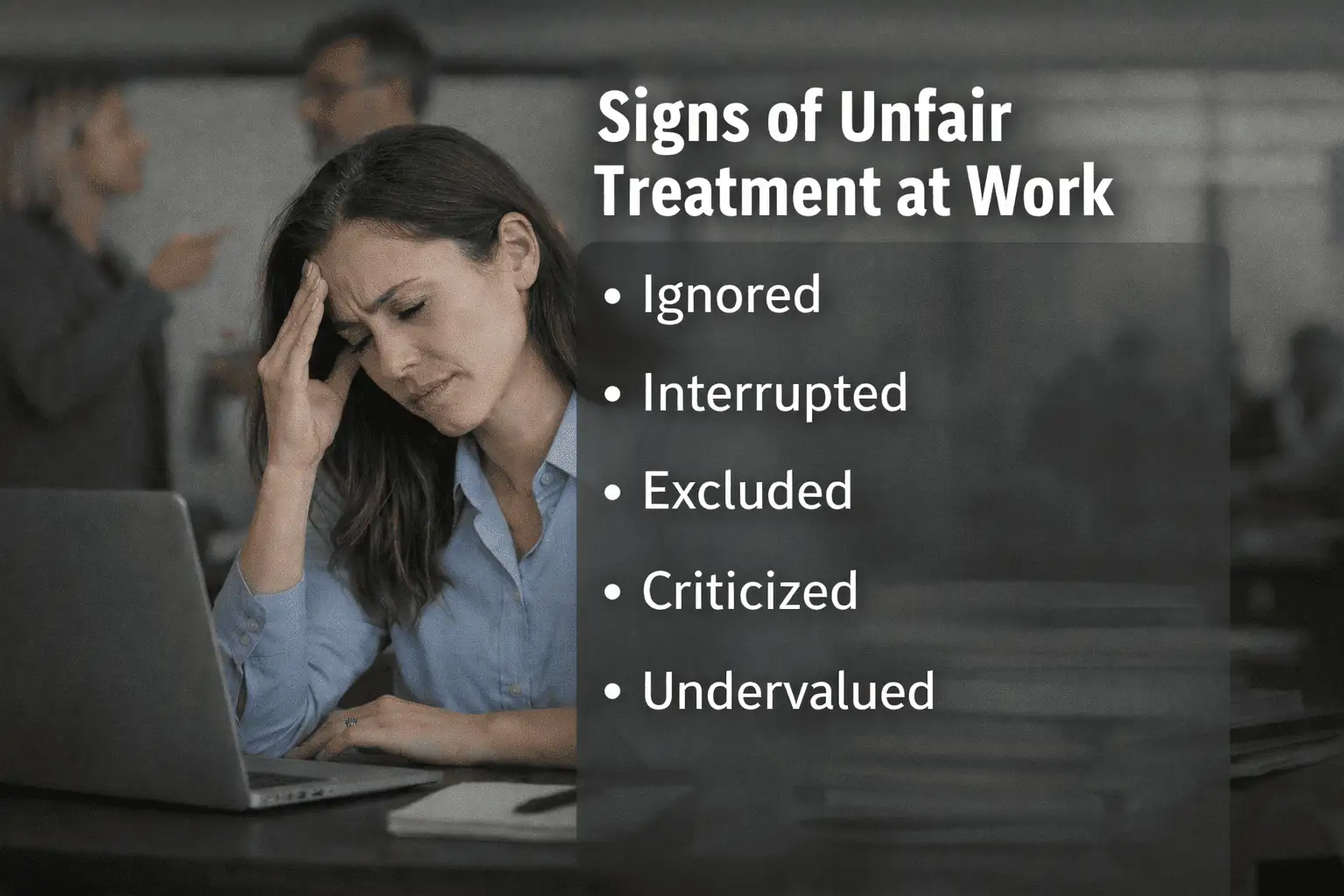
If you’re unsure whether you’re actually being treated unfairly, check out these signs of unfair treatment at work:
- Your work is excellent, you’re doing it with complete dedication, yet you don’t receive appreciation for your work, and this has been happening to you for a long time.
- Some people around you create such an atmosphere that you go into defensive mode in every meeting.
- Whenever you speak in meetings, you’re always cut off, and this happens to you in every meeting.
- Whenever a decision is made regarding work, you’re always excluded from the decision.
- Whenever you receive feedback, it’s always negative and filled with anger. You receive feedback that criticizes you but offers no guidance for improvement.
It is worth noting here that if these things happen to you over a long period of time. There’s a good chance you are re receiving unfair treatment.
Unfair Treatment in the Workplace vs Tough Management
| Tough Management | Unfair Treatment in the Workplace |
|---|---|
| Expectations are clear and apply to everyone | Rules are enforced only for certain employees |
| Work pressure is shared across the team | Pressure and responsibility fall on one or two people |
| Feedback focuses on improvement and growth | Feedback feels personal, critical, or one-sided |
| Performance is reviewed using the same standards | Performance is judged inconsistently or unfairly |
| Discipline is meant to improve team results | Discipline is used to control or single someone out |
| Mistakes are addressed fairly across the team | Mistakes are highlighted for some and ignored for others |
| Growth opportunities are open and transparent | Promotions and chances are given selectively |
If expectations and pressure are the same for everyone then it is tough management.
If rules and pressure target only a few people then it called unfair workplace treatment.
When Work Stress Affects Mental Health
Unfair treatment is not just an office issue; it also starts spoiling personal life and slowly mental issues start arising. People at home often tell you not to bring office stress into your personal life, but when you are treated unfairly every day, your sleep gets disturbed, you don’t feel like talking and your family relations also start getting spoiled and you don’t realize it at first. You understand the reason only when problems starting at home.
Why Unfair Treatment Goes Long
Many employees know they are being treated unfairly at work and want to speak up but they are afraid to do so because they fear that speaking up will lead to losing their job and their managers will target them even more also HR will side with management.
A good HR manager will know their responsibilities and can stop it. You can share our blog “What are HR Responsibilities” with your HR manager so that they can know about their real responsibilities.
Steps to Handle Unfair Treatment
It is not true that you cannot speak up against unfair treatment at work. You can follow some steps to remove unfair treatment at workplace
Document Everything
In this step, document your emails, chats, and task allocations and keep a record of everything.
Think with facts, not emotions
Whenever you talk to a superior, talk based on facts and tasks, not emotions, so you’ll have a chance to prove your point.
Try Direct Communication
When the company is very large, the manager may not even know you’re working. You may start feeling ignored or treated unfairly. Instead, try to talk to them directly and explain your work.
Approach HR
In this step, you should approach HR whenever you feel that the same unfair treatment is happening to you repeatedly.
Value yourself
When you feel that you have raised your voice against unfair treatment but the same thing keeps happening to you and no solution is found, then you can change the company.
Is Workplace Unfairness Against the Law
Unfair treatment at work is not always illegal, but it can still be mentally and professionally damaging, hence its reality needs to be understood before taking any legal action. You can share our blog with your HR or manager and tell them how to monitor employees in a fair manner.
Final Thoughts: It’s Not Your Fault
If you are experiencing unfair treatment at work, it does not mean you are weak, it only means that you are part of a wrong system and you expect clarity and fairness from such a system.
A good workplace gives salary, respect and clarity as well, but if you are working in a bad system where fairness is missing, then asking questions is not wrong, but is necessary.