See Productivity in Real Time.
Monitor employee activity, track work hours, and improve team efficiency with powerful insights.
Most business owners think that employees spending more hours in the office means they work more. But this is not 100% true because when you calculate employee productivity vs hours worked you may get the opposite result.
Research shows that workers are fully productive and focused for 2.5 to 3 hours during an 8-hour workday. If an employee works more than 40 to 45 hours a week it can lead to low energy and reduced focus.
That means when your employee spends more time at the desk it does not mean equal output. In the modern workplace understanding attendance and working hours is not enough to measure employee performance, you need to understand how much employees contribute to company goals and overall success. That is why understanding the difference between employee productivity and hours worked is important.
What Is Employee Productivity?
Employee productivity means the amount of work completed within a specific time. It measures how efficiently an employee uses their time and it includes
- Number of completed tasks
- Project delivery
- Achieved sales targets
- Solved customer issues
- Achieved goals
- Work quality
What Are Hours Worked?
The time an employee spends on work-related activities is called hours worked and it includes
- Regular working hours
- Overtime
- Meeting time
- Training sessions
Tracking working hours helps you
- Manage attendance
- Payroll processing
- Follow labor laws
- Workforce planning
Key Difference Between Productivity and Hours Worked
| Factor | Employee Productivity | Hours Worked |
|---|---|---|
| Focus | Results and completed work | Time spent working |
| Measures | Amount and quality of work completed | Total hours worked |
| Goal | Better performance and higher output | Tracking attendance and work hours |
| Quality | Considers work quality | Does not measure work quality |
| Business Impact | Helps improve business growth | Helps with payroll and scheduling |
Why Working Longer Hours Doesn’t Always Increase Productivity
Some of the most common effects of extra work hours include the following:
- Lesser focus & much reduced concentration
- Poor work productivity eventually
- More mistakes and the need to rework again and again.
- Greater stress levels at work & mental fatigue
- Declined job satisfaction & lowered employee morale
- Higher employee burnout risk
How to Measure Employee Productivity
By looking at attendance, you cannot measure employee productivity. You must use many productivity metrics like
Task completion rate
- How many tasks were completed
- Whether the task was completed on time or not
- How many tasks are still pending
Goal achievement
- Monthly goals
- Quarterly goals
- Project milestones
Work Quality
- Accuracy
- Customer feedback
- Project error rates
- Overall quality of work
Project Delivery
- Deadlines are met
- How well team members collaborated
Use Automated Tracking Software
One of the best tools for tracking employee productivity is WorkDesQ, It gives you accurate data on employee productivity vs hours worked.
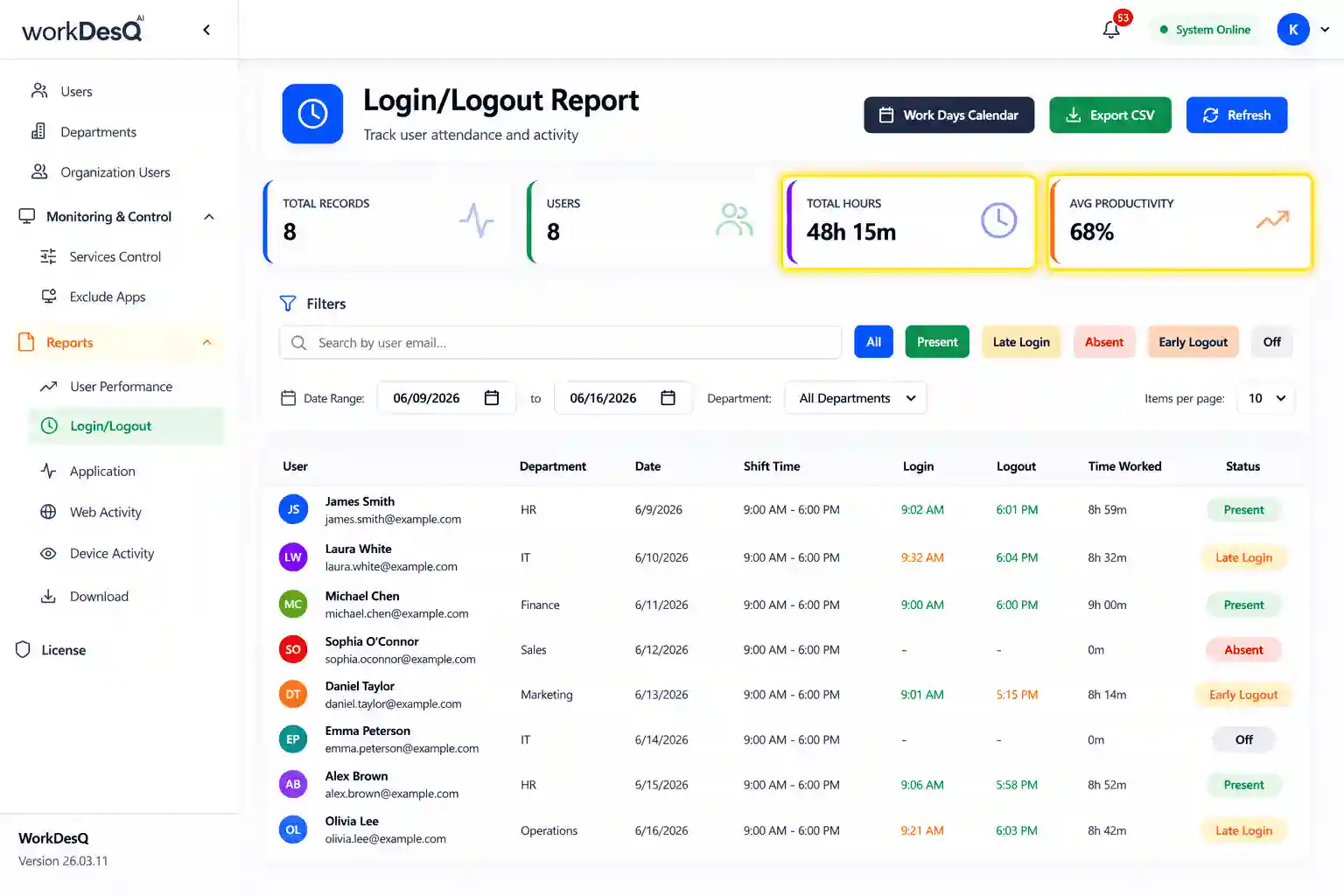
Want to see the real difference between employee productivity vs hours worked? Sign up today
Sign up today with WorkDesQ and track performance in real time
Maximum Productivity Starts with the Right Work Schedule
Studies from varied segments show that workers tend to be most productive when they stick to healthy work routines and take regular breaks in between tasks. While the optimal work hours for maximum productivity might differ depending on the job role, many experts tend to agree that staying focused consistently is far better than extended working hours. Generally speaking, productive workers mostly do the following:
- They work on high-priority tasks first
- They take regular short breaks to recharge.
- They try to minimize interruptions and distractions.
- They always maintain a healthy work-life balance.
- They always emphasise quality over quantity
Knowing Why Time Management vs Productivity Metrics Matters
In fact, proper planning usually leads to better outcomes than just putting in long working hours. When we draw the comparison between time management vs productivity metrics, it reveals that workers, who organise their workload well, tend to accomplish more within regular work hours only without the need of extending their work time further. Modern-day progressive productivity tools help workers focus more on priority tasks instead of wasting their time on low-value tasks at job.
Comprehending the Relation Between Quality of Work vs Hours Worked
More & more firms are today starting to see the great significance of quality of work vs hours worked. What truly matters is delivering work that is accurate, creative and valuable rather than spending more hours on the same tasks. In fact, a well-done project finished in 6 hours usually brings more business value than a low-quality project produced in 10 long hours.
Presenteeism vs True Productivity: Why Being Busy Is Not Enough
A very big challenge that businesses are facing today is presenteeism vs true productivity. Presenteeism usually happens when workers are present in the office physically but they aren’t fully productive either because of exhaustion or mounted work stress or simply due to lacking motivation. Conversely, true productivity is all about meaningful work contributions, a highly problem-solving approach, & accomplishing goals in given time periods only without extending the time further. Business units that address such presenteeism usually witness improvements in both workers’ wellbeing as well as overall organisational performance.
Employee Productivity vs Hours Worked: Common Mistakes
- Focusing on the total number of working hours
- Assuming that employees who work longer are more productive
- Ignoring main factors like teamwork, customer feedback and work accuracy
- Measuring employee activity instead of actual output
- Ignoring missing deadlines
- Ignoring breaks and work-life balance
- Focusing on attendance instead of performance
- Ignoring employee skills and tools
- Not measuring employee productivity per hour
Concluding the Debate
When we do the debate around employee productivity vs hours worked, one thing becomes very clear: and that is, longer working hours don’t lead to better work outcomes. Firms prioritising outcomes, productivity, quality, process efficiency, & worker wellbeing are far more likely to get sustainable success in the long run. Rather than asking how long employees work, firms must ask how efficiently they have been working regularly. This is where real productivity starts.
Are you searching for great solutions to track worker performances in your office, boost your business productivity, and construct a much more efficient workplace? You can visit WorkDesQ to see how modern-day workforce intelligence could really assist your teams to accomplish better outcomes without working long hours.