See Productivity in Real Time.
Monitor employee activity, track work hours, and improve team efficiency with powerful insights.
Flexible work schedule policy examples help companies create a clear policy for employees who want to work in flexible hours. A good professional work schedule policy explains everything like who is eligible to send requests for flexible working hours, what work options are available and how the approval process works.
Most of the companies offer flexible work because they give importance to employee work life balance and companies want to improve employee productivity. A well written flexible work schedule policy helps managers to make fair decisions and reduce confusion.
If you want to build a strong flexible team, it is very important to understand flexible work schedule policy examples because with the help of this example you can make good flexible work schedule policy.
What Is a Flexible Work Schedule Policy?
A flexible work schedule policy is a formal document which explains how employees work flexible hours.
Let us understand with an example
In a company the normal office timing is 9 AM to 5 PM, but if employees work with flexible hours, they can start working at 7AM to 3PM or 10AM to 6PM and these working hours are called flexible work hours.
10 Flexible Work Schedule Policy Examples Every Company Can Use
Here are some common flexible work schedule policy examples which are most commonly used
1- Flexible start and end time policy
In this policy employees can choose when to start and end work within fixed range
Example
- Office timing 8AM to 6PM
- Every employee has to complete 8 hours
- Employees can start work anytime between 8AM to 10AM
- If someone starts work at 8.30 AM, then they can finish at 4.30PM
2- Compressed workweek policy
In this policy employees work more than 8 hours a day but work 4 days a week
Example
-
- Work 4 days
- 10 hours each day
- Friday is off in every week
3- Hybrid work schedule policy
Employees work from home on some days and from the office on other days.
Example
-
- Monday, Tuesday and Wednesday – work from office
- Thursday to Friday – work from home
4- Remote flexible hours policy
In this work schedule policy employees work from home and can also choose flexible hours.
Example
-
-
- Remote employees work 8 hours between 7AM to 8PM
- Must attend meeting between 11 AM to 2PM
- Daily task must be completed before the end of the day
-
5- Staggered shift policy
In this policy employee can work according to different shifts and it reduces overcrowding
Example
-
-
- Shift 1 – 7AM to 3PM
- Shift 2- 9:00 AM – 5:00 PM
- Shift 3- 11:00 AM – 7:00 PM
-
6- Core hours policy
Employee can choose work hours but employees should be available during fixed hours
Example
-
- Core working hours- 10AM to 3PM
- Employee can complete their work before or after core working hours
7- Part time flexible schedule policy
Part time employees choose working hours according to business requirements and after manager approval
Example
-
- Employee works 20 hours in week
- The working schedule is final after manager approval.
- Weekly plan must be shared in advance
8- Shift swap policy
Under this policy employees can exchange their work schedule with any employee but it should be approved by the manager before the exchange.
Example
-
- James (employee A) can exchange shift on Tuesday with Benny (employee B)
- Both employees should inform the manager.
- The shift changes when the manager approves it.
9- Seasonal flexible schedule policy
Companies change work schedule according to seasonal requirements
Example
-
- Employee work 9 hours in a day in busy season
- Employees return to 8 hours a day in slow season
- Changes are announced before 2 weeks
10- Result based flexible schedule policy
Employees are judged by their completed work instead of their working hours.
- Employee must finish their work before deadline
- Work hours can be changed.
- Performance is evaluated based on work quality and deadlines
Flexible Work Schedule Policy Example Template
Flexible Work Schedule Policy Template
Company Name: Example Solutions Pvt. Ltd.
Policy Effective Date: 1 July 2026
Department: Human Resources (HR)
1. Purpose
Write the purpose of the flexible work schedule policy.
2. Eligibility
Explain who can apply for this policy.
3. Available Flexible Work Options
- Remote work
- Hybrid work
- Compressed workweek
4. Working Hours
- Total working hours per week
- State whether the lunch break is included or excluded.
- Overtime rules
5. Core Working Hours
Example: 10:00 AM to 3:00 PM
6. Request Process
- The employee submits a written request to the manager.
- The manager or HR reviews the request.
7. Employee Responsibilities
Explain employee responsibilities and deadline requirements.
8. Manager Responsibilities
Explain the manager’s responsibilities for flexible work schedules.
9. Schedule Changes
Explain the process for requesting schedule changes.
10. Employee Acknowledgment
I confirm that I understand the flexible work schedule policy and will follow the company rules.
| Employee Name | |
| Employee ID | |
| Department | |
| Manager Name | |
| Employee Signature | |
| Manager Signature | |
| Date |
Why Companies Need Flexible Work Schedule Policy Examples
Here are some main reasons why companies need flexible work schedule policy examples
- Help to create policy faster
- Show what rules can be included in the policy.
- Give ideas for different work schedules.
- Make it easier to customize the policy anytime.
- Keep policies clear so everybody can understand
- Help HR to save time
- Understand real workplace ideas for how to make strong flexible work schedule policy
Main Points to Look for in Flexible Work Schedule Policy Examples
- Eligibility
Clearly mention in the policy which employee can request for flexible work
- Available work options
When you see any policy please check, policy must have different work hour options
- Core working hours
Policy mentions some fixed working hours so that everybody is available to attend meetings
- Approval process
Policy should explain how employee request for flexible work schedule and who approves the request
- Attendance rules
Described how employee attendance can be tracked
- Communication rules
Under the policy examples, it should be mentioned that how employee can contact their managers
- Policy review
Mention that company can review and update or end a flexible work option at any time
- Company rules
Policy should be clear that employee must follow company rule and policies
- Simple and clear language
Policy examples should be in clear and simple language so employees can quickly understand
If you want to learn how to create an 8-hour work schedule for one week, read our detailed blog. It explains the process with simple examples, templates and easy tips.
Who Should Use Flexible Work Schedule Policy Examples?
- Business owners who want to start flexible work hour options in company
- HR managers who want to create a flexible work schedule policy
- Team leaders who want to manage flexible work schedule easily
- Small business owners who are making a policy for the first time
- Remote and hybrid companies that create clear rules for working from employees and hybrid employees
- HR consultants who create policies for different companies
Benefits of Understanding Flexible Work Schedule Policy Examples
- It helps to create quick and easy policy because you already have an example
- Easy to set clear rules like working hours, approval process, attendance and employee responsibilities
- Companies can customize policy in short time
- HR and manager get many flexible work schedule ideas from examples
- Easy to understand different work options like remote or hybrid or compressed workweek
- After understanding the examples you can create a professional policy for both employees and employers
- With work schedule policy examples new businesses get guidance
Mistakes to Avoid in Policy Examples
- Do not copy and apply any policy example in your company without editing
- You should not ignore eligibility sections
- Check working hours and ensure daily, weekly and monthly hours mentioned in policy example
- Do not ignore core working hours
- When you read policy examples do not miss employee responsibilities
- Do not use outdated policy examples
- Select only policy example which is written in easy language
- Do not depend on only one example. Check multiple flexible work schedule policy examples.
How WorkDesQ Helps Track Flexible Work Schedules
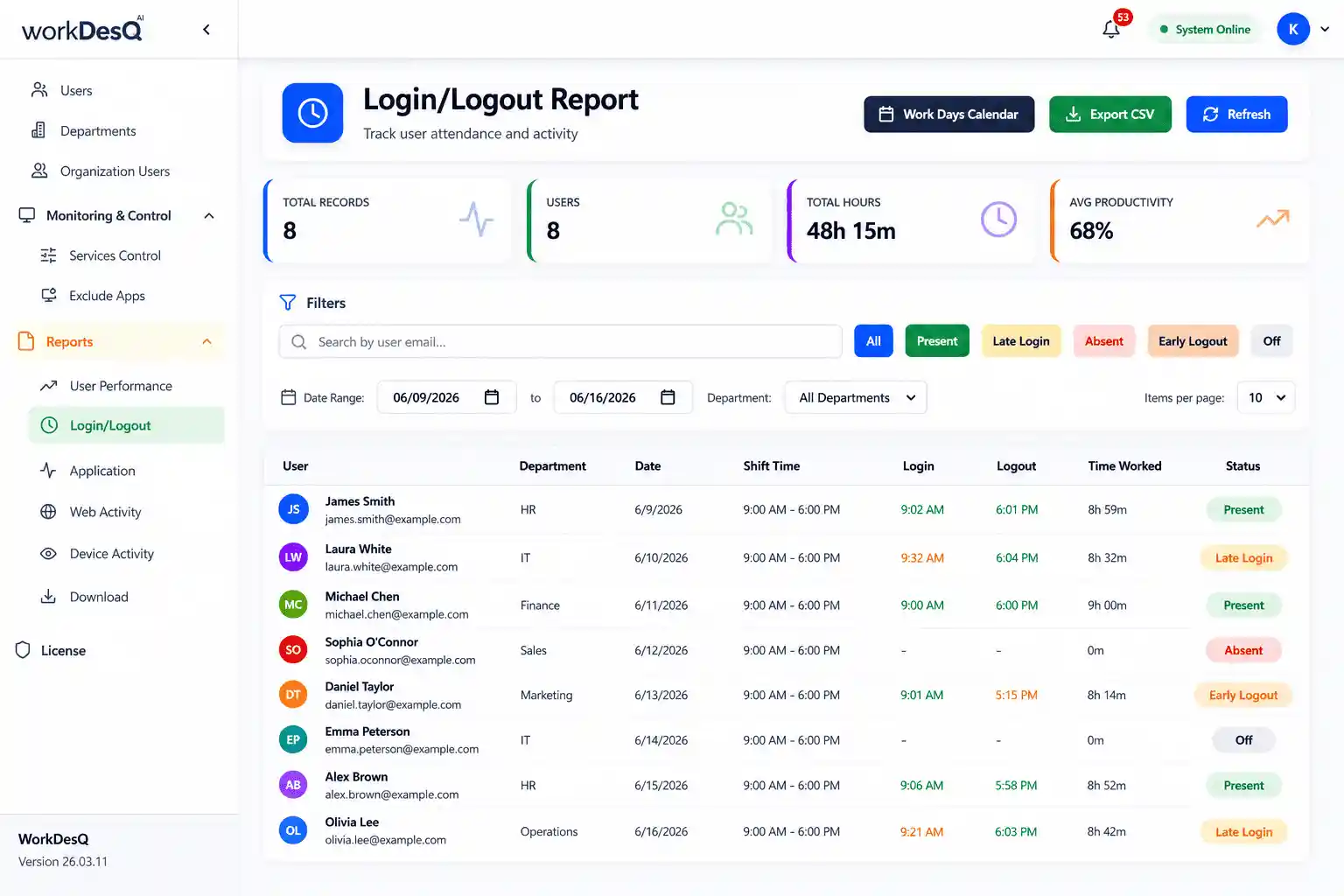
It is so difficult to track flexible work schedules through manual methods and it comes with lots of mistakes. Here are some ways WorkDesQ helps you.
- Track employee working hours automatically and you get a clear view from one dashboard
- Monitor remote hybrid or compressed workweeks like who is present, who is absent or who is on leave
- Improve team visibility so managers always know which employee is available in business hours
- Save time for HR team by reducing paperwork and manual attendance tracking
- Help businesses maintain policy compliance by tracking employee work schedules according to company rules
- Help managers plan schedules by making it easier to manage employee working hours.
Attendance Usage Tracking Software
Keep every flexible work schedule organized, accurate and easy to track with WorkDesQ.
Conclusion
For understanding clear policy, you need to understand flexible work schedule policy examples, so you can make data driven decisions and make good policy for your company. Flexible work schedule examples clearly explain who is eligible to send a request for flexible working hours, how it works and who approves flexible work hours request,
Every business has different goals, markets and sizes so you have to mention all major parts of flexible hours, the language should be kept simple. and apply fairly.