The job of an HR person is not only to manage employees. Sometimes even skilled employees miss deadlines or have problems with behavior at work. The real job of an HR professional or manager is to identify employee performance issues and resolve them without breaking trust or lowering morale.
This is why HR professionals and managers seek out performance improvement plan examples because they help guide employee performance improvement.If properly structured, a powerful performance improvement plan is a powerful tool. If you are an HR manager, you will learn:
- What is a PIP? What is its purpose?
- How should an HR professional implement one?
- Key Parts of a Good Performance Improvement Plan
- Step Guide to Create a PIP
- Real-life PIP examples: attendance, productivity, communication skills.
- How can WorkDesQ help with PIP tracking and employee improvement?
- Templates, checklists, and best practices
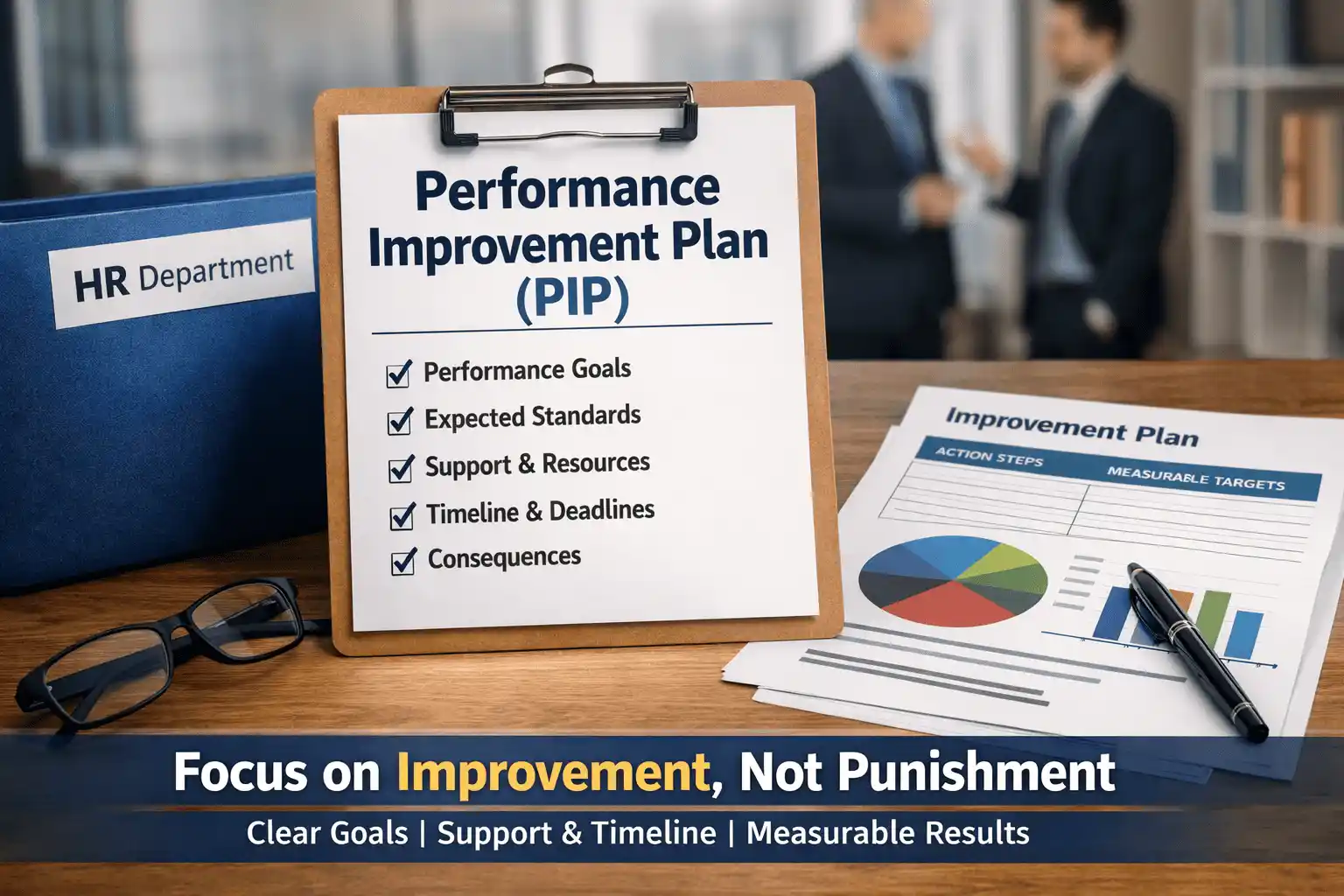
What Is a Performance Improvement Plan (PIP)?
A PIP is a formal document that HR professionals issue when an employee’s performance needs to improve because it gives a clear path. A PIP typically includes:
- Performance plan
- Expected standards
- Improvement goals
- Support and resources
- Timeline
- Consequences
Its goal is not to punish the employee. It is a structured agreement between the employee and the company to ensure success. A PIP addresses questions like what is going wrong, what needs to be changed, and how to measure improvement. HR cannot figure out where the problem is and cannot implement a performance improvement plan.
Why HR Needs a Performance Improvement Plan
Ignoring performance issues can be a serious mistake for an HR professional or manager. HR is needed when employee performance is declining. HR needs to address employee needs.
| Reason HR Uses a PIP | Simple Explanation |
|---|---|
| Clear Expectations | A PIP tells employees what they need to improve in their work. |
| Improve Performance | It helps employees understand their mistakes and work better. |
| Set Clear Goals | HR and managers set specific goals for the employee to achieve. |
| Track Progress | The company can check if the employee is improving or not. |
| Fair Opportunity | Employees get a chance to fix their performance problems. |
| Better Communication | It helps managers and employees talk clearly about work issues. |
| Reduce Conflicts | Written plans reduce misunderstandings in the workplace. |
| Support Employee Growth | A PIP helps employees learn and grow in their role. |
Main Benefits of Using a Performance Improvement Plan
| Benefit | Simple Explanation |
|---|---|
| Better Work Performance | A PIP helps employees focus on doing their job better. |
| Fair Opportunity | Employees get a chance to fix their mistakes. |
| Better Communication | Managers and employees talk openly about problems. |
| Skill Improvement | Employees can develop new skills and improve weak areas. |
| Progress Tracking | HR can track the employee’s improvement over time. |
| Stronger Team Results | When one employee improves, the whole team performs better. |
10 Real Examples of Performance Improvement Plans
| # | Staff | Role | Issue | Goal | Actions | Time | Result |
|---|---|---|---|---|---|---|---|
| 1 | John Miller | Marketer | Late work | Finish tasks on time | Task list, Daily updates, Calendar | 30 days | Submits work on time |
| 2 | Sarah Johnson | Support | Poor communication | Give clear info | Training, Reply check, Manager review | 45 days | Fewer complaints |
| 3 | Michael Brown | Entry | Low output | 40 records/day | Stay focused, Track work, Weekly review | 30 days | Works faster |
| 4 | Emily Davis | HR | Late arrival | Come on time | Reminders, Travel plan, Attendance | 30 days | Regular attendance |
| 5 | David Wilson | Designer | Mistakes in designs | Fewer errors | Check work, Follow checklist, Feedback | 45 days | Better design quality |
| 6 | Daniel Smith | Sales | Not following process | Follow sales steps | Guide review, Training, Manager check | 30 days | Correct reports |
| 7 | Jessica Taylor | Project | Poor teamwork | Work with team | Meetings, Updates, Feedback | 45 days | Smooth teamwork |
| 8 | Robert Anderson | Service | Rude calls | Be polite & patient | Training, Manager review, Follow script | 30 days | Happy customers |
| 9 | Amanda White | Marketing | Slow learning tools | Use new software | Training, Practice, Weekly review | 45 days | Works faster |
| 10 | Christopher Lee | Writer | Unfinished tasks | Complete all tasks | Task list, Manager update, Weekly review | 30 days | Tasks done on time |
Simple Steps to Create a Performance Improvement Plan
HR professionals need to follow certain steps to create a clear, fair, and effective PIP.
Identify performance issues
First, you need to find the performance issue, and if you need to do it quickly, you can use our WorkDesQ software to track employee productivity
Set measurable goals
Goals should always be smart, specific, relevant, and time-bound.
Provide support
While the employee is working on the performance improvement plan, provide support to help them improve their performance.
Timeline
Minor issues 30 days, moderate 60 days, and major 90 days
Schedule regular reviews
Weekly check-ins using PIP progress reports and WorkDesQ reports
Document everything
Record conversations, progress reports, and outcomes
Define Results
Common Mistakes HR Should Avoid in a PIP
Many HR managers make a mistake when they create a performance improvement plan that the employee cannot clearly understand. Because of this, HR should be careful and avoid these mistakes
- If the problem is not explained clearly in the PIP, the employee may feel confused and may lose trust.
- Failing to set realistic goals, because unless the employee knows which goal to achieve, they will remain confused.
- Failing to support the employee during the PIP, which prevents them from improving. You will need to provide them with training or guidance support.
- Poor communication: You issue a PIP to the employee but then do not discuss it with them. Need help?
- Not tracking their work progress. This prevents you from knowing how much improvement the employee has made. You can use our WorkDesQ employee monitoring tool to track work progress.
If you avoid these mistakes, you can create a successful performance improvement plan and implement it better.
How HR Tracks PIP Progress Effectively
| Week | Goal | Task / Activity | Status | Feedback | Next Step |
|---|---|---|---|---|---|
| Week 1 | Complete tasks on time | Submit daily work reports before deadline | In Progress | Work improving but still some delay | Focus on time management |
| Week 2 | Improve communication | Attend team meetings and give updates | Good | Communication better than last week | Continue same approach |
| Week 3 | Increase productivity | Complete assigned tasks daily | Needs Improvement | Some tasks still incomplete | Prioritize important tasks |
| Week 4 | Maintain work quality | Reduce errors in reports | Good | Quality of work improved | Keep checking work before submission |
| Final Review | Overall improvement | Review performance from past weeks | Pending | Final decision based on progress | Continue role or further action |
Real Example: How an Employee Improved With a PIP
Example David is in sale department
David works as a sales representative in the company. For the past few months his sales numbers were lower than the team targets. Because of this his manager decided to help him improve instead of taking strict action.
Manager made best PIP for David
Result:
After 2 months, David’s performance improved a lot. His sales conversion rate increased by 30%. This example shows that a structured PIP combined with tools like WorkDesQ can help employees improve faster and perform better at work.
Final Thoughts on Performance Improvement Plans
Performance related problems arise in the workplace without notice. HR professionals should always be prepared for them. PIP should be used for improvement purposes and not for employee termination. Because employee performance is not always permanent, first understand the issue and then take action. We have given many performance improvement plan examples. You can use them as needed but follow the complete PIP process from the first step to the last step.