See Productivity in Real Time.
Monitor employee activity, track work hours, and improve team efficiency with powerful insights.
Leave management in HR is a process of handling employee leave requests, approvals, tracking leave balance, and maintaining accurate data of leaves. It helps companies to manage employee availability without any work disruption and make sure smooth business operations run smoothly.
Introduction: Understanding Leave Management in HR
In every company, employees need to take leave at some point whether it is for personal work, health issues, or vacations. If employee leaves are not managed in a proper way, then workflow can be disturbed that is why understanding what leave management in HR is very important.
In a simple way leave management is the process where leave is managed from start to end like from application to approval. In this these steps are included
- Employee applies for leave
- Manager might approve or reject
- Track leave balances
- Leave records are stored in HR system
Many companies still manage leaves in Excel which leads to confusion, delay and full of mistakes that it is more important to understand what is leave management in HR because it helps businesses and HR professionals when your company follows proper leave management system it helps you
- Smooth workflow
- Mistake free salary calculation
- Employees feel more satisfied
Why Leave Management is Important for HR
If you think that leave management only to track to leaves but this is not true because it affects directly company operations like
Avoid work disruption
If leaves not properly tracked then workload is imbalanced in team and with help of proper system you can manage planning better
Better employee experience
When employee leave is handled through fair methods, it builds trust and improve job satisfaction
Accurate payroll
For calculating accurate payroll you need learn 5 basic steps in processing payroll and if you not follow these steps ,it leads to
- Overpayment
- Underpayment
- Salary mistakes
Types of leaves in leave management
Before Understanding leave management, you should understand types of leaves and its very important
1 Sick leave
This leave take employee when he or she suffering from disease and this leave help employee recover fast form disease also leave prevent form spread infection in office
2 Causal leave
This leave use for short term work like family reason, urgent personal work a daily life issue
3 Earned leave
This leave use for long vacations and this is a paid leave
4 Maternity leave
This leaves available for females only and it is used when female employees at child birth
5 Paternity leaves
This leaves for males so that they support family
6 Leave without pay
When leave balance used up employee can take unpaid leave
What is the Role of HR in Leave Management
HR plays an important role in tracking leaves and ensure it runs smoothly without any mistakes
Step 1: Create Leave Policy
HR makes a clear leave policy including types of leaves, limits and rules so that employees know they eligible for
Step 2: Manage Leave Requests
HR monitors leave applications submitted by employees through system or email
Step 3: Coordinate with Managers
HR works with managers and ensures leave approvals are aligned with the team
Step 4: Verify Leave Balance
HR also checks whether employees have enough leave balance before final approval
Step 5: Maintain Records
HR update and maintain accurate data in record system
Step 6: Ensure Payroll Accuracy
HR records leave data securely because it helps in calculating salaries
Common Problems of Leave Management in HR
Managing leaves is not an easy task for any HR below are some of the most common problems
Manual work mistakes
Many companies still use excel or paper to track leave this can cause wrong data entry and confusion in leave balance
Information is not clear
employees usually do not know how many leaves they have and if their leaves approved or not
Slow leave approval
Managers may busy in some other important tasks so leave request get delayed and sometimes request is missed
Hard to track leaves
Because employees have too many types of leaves like CL, SL and PL in result HR face lots of confusion which leave employee taken
Misuse of Leave
If leave management does not follow a proper system employee can take too many pail leaves (PL)
Rules and Legal Problems
If records may not be proper companies can be in compliance risk.
How HR Manages Leave in Excel
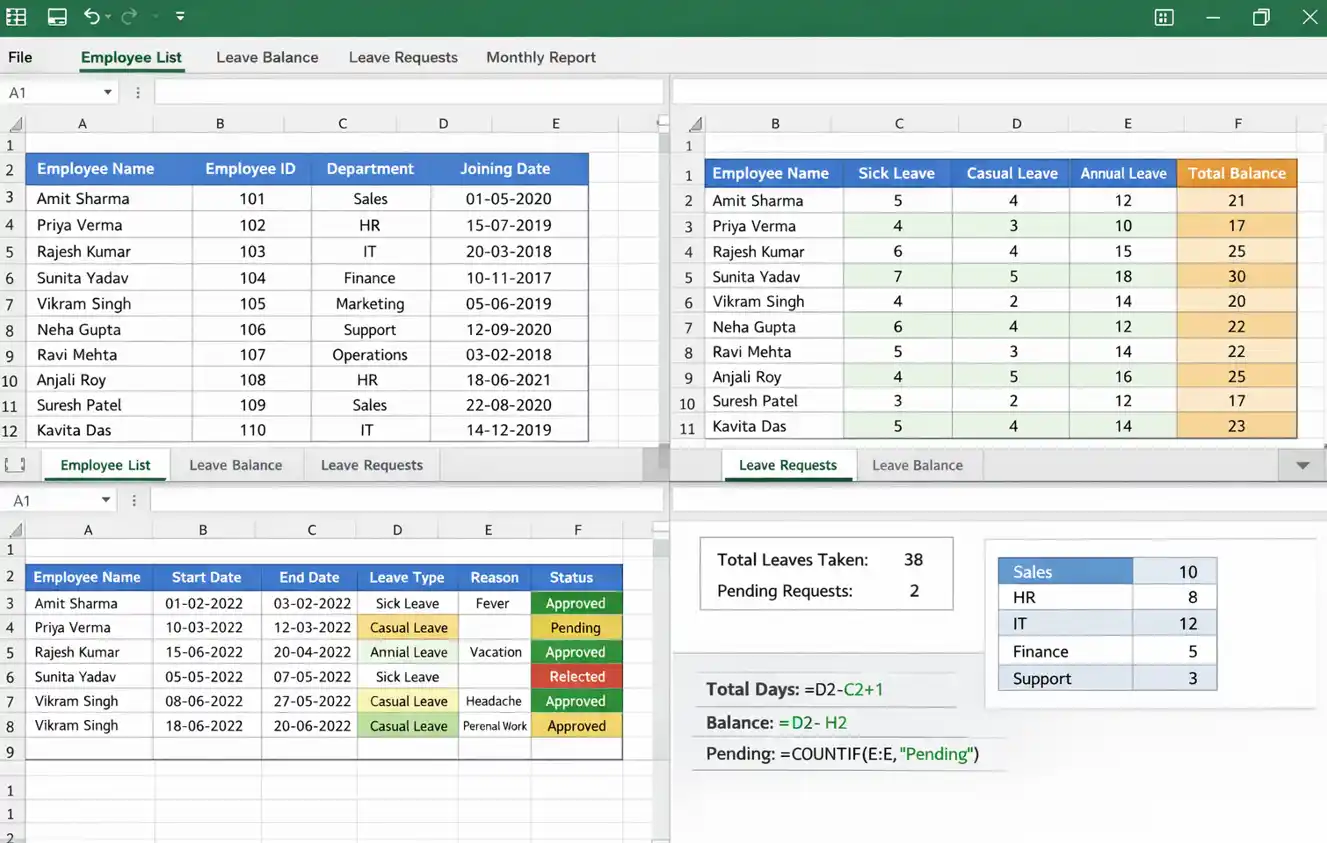
Employee List Sheet
- HR creates a sheet that has all employees details
- Employee Name
- Employee ID
- Department
- Joining Date
This helps HR keep all employee records in one place.
- Leave Balance Sheet
This sheet shows how much leave each employee has.
- Sick Leave
- Casual Leave
- Annual Leave
- Total Leave Balance
HR sets the starting leave balance and updates it after every leave.
- Leave Request Sheet
This sheet contains all leave requests from employees:
- Name
- Leave Start Date
- Leave End Date
- Leave Type
- Reason
- Status (Approved / Pending / Rejected)\
- Simple Excel Formulas Used
Excel formulas make the work easy:
- To calculate total leave days (End Date – Start Date)
- To reduce leave balance after approval
- To count approved and pending leaves
- Approval Tracking
HR or manager updates the leave status:
- Approved
- Rejected
- Pending
Colors are also used:
Green = Approved
Red = Rejected
- Monthly Report Sheet
At the end of every month, HR makes a report:
- Total leaves taken
- Department-wise leave details
- Remaining leave balance
Download leave management Excel
Benefits of Leave Management in HR
All data in one place
When leaves managed through proper system it keeps everything in one place like
For HR – they can see quickly who is available before leave
For employees – they can check their leave balance any time
Reduce manual work
HR cannot do everything at the same time if it is HR software based no need to excel again and gain and save time for HR
Quick leave approval
The process becomes fast and smooth so that employee can apply in second and HR can approve with just on click
Useful data for HR
HR can see leave pattern of employees and help in making decisions
Manual vs Automated Leave Management
| Feature | Manual Leave Management | Automated Leave Management |
|---|---|---|
| Time | Takes more time to manage leave | Saves time with quick process |
| Accuracy | Mistakes can happen easily | Very few mistakes |
| Leave Tracking | Hard to check leave balance | Easy to check anytime |
| Approval | Slow approval process | Fast approval |
| HR Work | More work for HR team | Less work for HR |
| Data & Access | Data is in files and hard to find | All data in one place, easy to access |
Key Features of Leave Management Software
When companies are running at an advanced level then they adopt HR software for managing leaves and software comes with many features like
Realtime notification
HR gets instant alerts when someone applies for leave through software
Leaves balance tracking
Software automatically calculates leaves
Integration with Payroll
Software helps in salary calculation
Reports and Analytics
Software automatically generate reports of leaves
Best Practices for Effective Leave Management in HR
- Keep data organized
- Use clear leaves policy
- Update leave balance properly
- Use simple excel formula
- Fast approvals
- Use color coding like green for approved and red for rejected
- Monthly review of leaves
Leave Policy: The Main Base of Leave Management
A strong leave policy is the foundation of whole system and good policy should include
- Types of leave
- Leave limits
- Approval process
- Carry forward rules
- LWP (Leave Without Pay) rules
Future of Leave Management in HR
As companies are growing, leave management is also changing.
Future trends include:
- Mobile-based leave systems
- AI-based predictions
- Attendance integration
- Cloud-based HR tools
Final conclusion
We hope you now understand what leave management in HR is and why it is important for every company. Quick recap
- This is a complete process for managing employee leave
- It includes request, approval, tracking, and payroll impact
- It improves employee satisfaction and business efficiency
- It reduces mistakes and saves time